
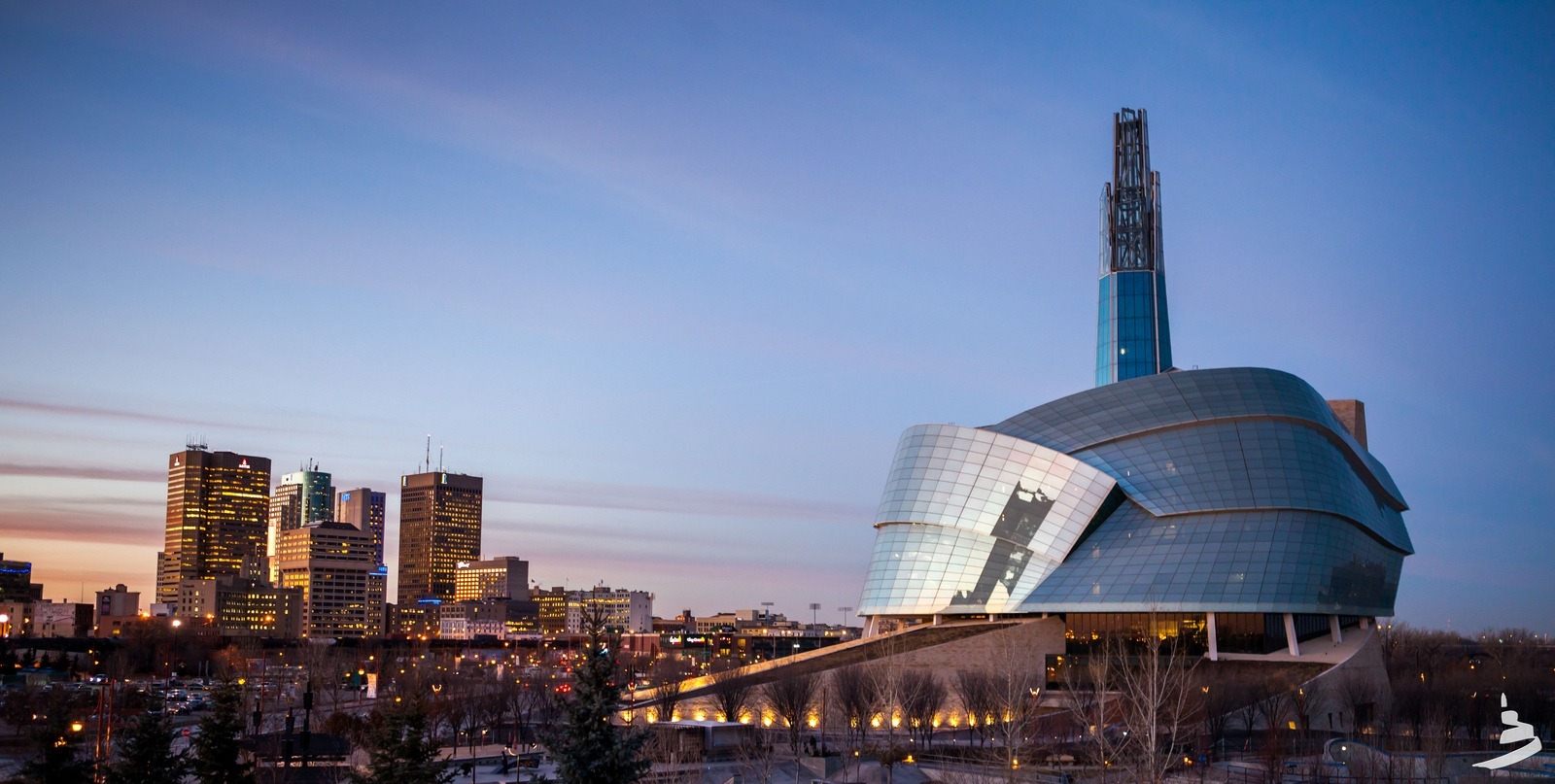
History of a unique museum
The Canadian Museum for Human Rights (CMHR) in Winnipeg is the world’s first museum dedicated entirely to human rights. More than just a cultural object, it is a true symbol of the struggle for equal rights for all and a place where visitors can reflect on the history of human rights, their evolution and future.
The history of the museum began with the dream of Israel Asper, a well-known Canadian philanthropist. In 2000, this businessman, lawyer and founder of media conglomerate Canwest Global Communications envisioned the creation of a world-class human rights center in Canada. Asper, as a proud and grateful Canadian, was a lifelong supporter of educational projects for Canadian youth. He saw the museum as a place where students from across Canada could learn about human rights, as well as an opportunity to revitalize downtown Winnipeg and attract tourists to the city.
on April 17, 2003, the 21st anniversary of the Canadian Charter of Rights and Freedoms, Asper and his supporters announced plans to establish the museum at The Forks Historic Park, the confluence of the Red and Assiniboine Rivers. The site has special historical significance: for thousands of years, indigenous peoples have used these waterways for peaceful negotiation, dialog, and trade. Sadly, just six months after the museum was announced, on October 7, 2003, Israel Asper passed away suddenly at the age of 71. After his death, his daughter Gail Asper took over leadership of the project, and the Friends of the Canadian Museum of Human Rights organization continued to bring his vision to life.
In 2003, an international architectural competition was announced, which received 100 entries from 21 countries. The winner was renowned American architect Antoine Predock of Albuquerque, New Mexico. His concept envisioned the museum as a journey beginning with a dive into the earth and ending with an ascent to the Tower of Hope. According to Predock, this project was the most important of his career.
In 2007, Canadian Prime Minister Stephen Harper announced the government’s intention to make CMHR a national museum. on March 13, 2008, the bill creating the museum received royal assent in Parliament, making it Canada’s first new national museum in more than 40 years and the first to be located outside the Capital Region.
a groundbreaking ceremony was held on December 19, 2008, and construction began in April 2009. on July 3, 2010, Queen Elizabeth II unveiled the museum’s cornerstone, personally selected by her from Runnymede, the English meadow where the Great Charter of Liberties was signed in 1215. The stone was engraved with an inscription from the queen and was embedded in Manitoba’s Tyndall stone.
The impressive museum building was officially opened on September 20, 2014, although construction took longer and cost more than originally planned. Total construction costs totaled about $351 million dollars.
Architectural concept: from darkness to light
The Canadian Museum of Human Rights building is one of the most amazing architectural creations in modern Canada. Antoine Predock created an innovative structure with curved lines and bold geometry. More than three-quarters of the building’s walls are at unusual angles, which required the use of advanced construction techniques, including 3D modeling.
The architect drew inspiration from Canada’s natural landscapes, including trees, ice, northern lights, and indigenous culture. Predock describes his creation as, “The Canadian Museum of Human Rights is rooted in humanity, making visible in architecture the fundamental commonality of humanity – a symbolic vision of ice, clouds and stone set in a field of sweet grass. Carved into the earth and dissolving into the sky on the Winnipeg skyline, the abstract ephemeral wings of a white dove embrace a mythical stone mountain of 450-million-year-old Tyndall Limestone, creating a unifying and timeless reference point for all nations and cultures of the world.”
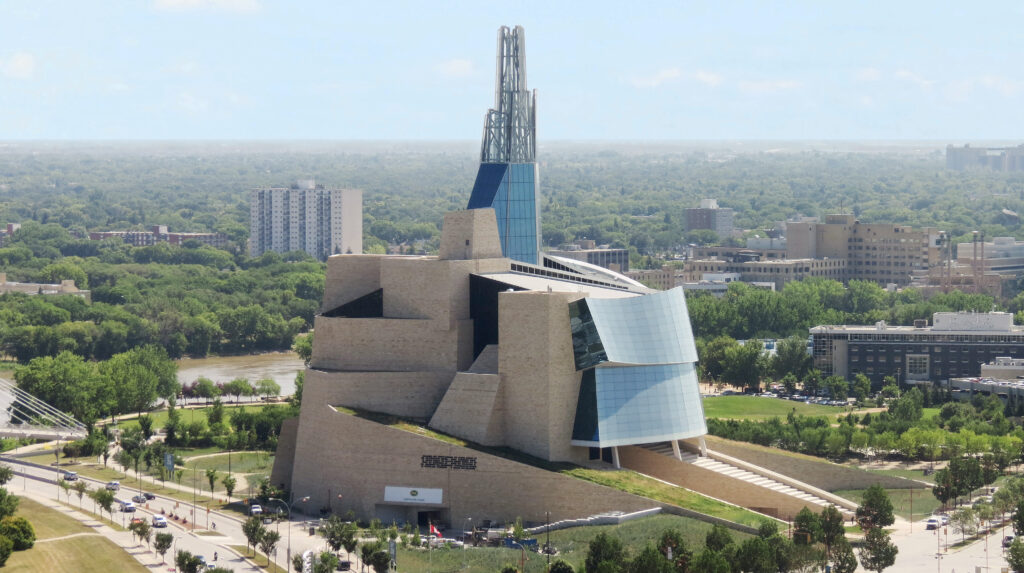
The most impressive elements of the building are:
- “Cloud of Glass,” a huge glass façade made up of 1,335 pieces of glass, each one unique. A total of 1,669 glass panels are used in the museum, and the framework of the Cloud contains 5,400 tons of steel.
- TheAlabaster Ramps are nearly a kilometer of passageways lined with alabaster. It is the largest project in history made using this material. More than 3,500 m² and 15,000 tiles of alabaster were used to create the Hall of Hope.
- TheIsrael Asper Tower of Hope is a 100-meter tall glass tower overlooking the museum, offering panoramic views of Winnipeg.
- TheContemplation Garden is a space with pools decorated with black Mongolian basalt.
The symbolism of the museum’s architecture has a deep meaning: the visitor’s journey begins at the entrance through the museum’s “roots” in the earth and ends at the Tower of Hope – a kind of journey from darkness to light, reflecting humanity’s progress in understanding and respecting human rights.

The interior space of the museum with alabaster ramps Architect Magazine
Exhibits: making sense of human rights
The Canadian Museum of Human Rights is not just a memorial to suffering, but an educational space designed to inspire visitors to think and dialog about human rights. The museum worked with the world’s leading museum design firm, Ralph Appelbaum Associates, to create impressive exhibitions.
Since opening in September 2014, the museum includes ten major permanent galleries:
- What are Human Rights? – an introductory gallery introducing visitors to the concept of human rights.
- Indigenous Perspectives, a gallery dedicated to understanding rights and responsibilities from an indigenous perspective. A circular movie about indigenous peoples’ concepts of rights and their relationship to the land is shown here. The centerpiece of the exhibit is Trace, a 2.5-story “ceramic quilt” created by artist Rebecca Belmore of the Anishinaabe people. This artwork reveals the traumatic history and ongoing violence against Indigenous peoples.
- Canadian Pathways is a gallery highlighting both the successes and failures of Canada’s human rights record. There are exhibits on Indigenous residential schools, missing and murdered Aboriginal women, the forced relocation of the Inuit, the internment of the Japanese during World War II, discrimination against people with disabilities, the Chinese tax, the Underground Railroad (for runaway slaves from the US), the Komagata Maru incident, and the Winnipeg General Strike.
- Protecting Rights in Canada – A gallery describing the legal mechanisms for protecting rights in Canada.
- TheHolocaust and Other Genocides – An exhibit on the five genocides officially recognized by Canada: Holocaust, Holodomor, Armenian genocide, Rwandan genocide and ethnic cleansing in Bosnia.
- Turning Points for Humanity – a gallery dedicated to key historical events that have influenced the development of human rights.
- Breaking theSilence – an exhibit using survivor testimonies and oral histories to give voice to those who have faced human rights violations.
- Action Matters – a gallery showing how the actions of individuals and groups can contribute to improving human rights.
- Rights Today – an exposition on contemporary human rights issues.
- Inspiring Change – a final gallery encouraging visitors to reflect and take action.

One of the Canadian Museum of Human Rights Ralph Appelbaum Associatesexhibits
It is important to note that Indigenous issues are addressed in each gallery, but are particularly detailed in the Canadian Pathways and Indigenous Perspectives galleries. The museum strives to be inclusive and accessible to all visitors, including people with various disabilities.
On the fifth floor of the museum is the Carte International Reference Center, a library “dedicated to collecting and providing access to resources that support human rights education and research.”
Controversies and criticisms
Despite its noble goals, the creation and operation of the Canadian Museum of Human Rights has been accompanied by a number of controversies and criticisms from various community groups.
The construction site and archaeological findings
The museum was built on The Forks, an important Indigenous archaeological site. From 2008 to 2012, archaeological excavations at the site uncovered more than 400,000 artifacts dating as far back as 1100 A.D. Retired archaeologist Lee Sims argued that the excavations conducted were not thorough enough, although museum officials claimed they consulted with Indigenous leaders and continued to do so during construction.
Controversy over the representation of various genocides and tragedies
In December 2010, a controversy erupted over plans to create two permanent galleries dedicated to the Holocaust and the oppression of Indigenous peoples in Canada. A number of community organizations representing Canadians of Central and Eastern European descent, including the Ukrainian Congress of Canada, protested what they called an overemphasis on the suffering of Jews and Indigenous peoples and relegating their own experiences (such as the Holodomor) to smaller thematic or temporary galleries.
Lubomyr Lutsyuk, speaking on behalf of the Ukrainian-Canadian Civil Liberties Association, stated, “As a publicly funded institution, the Canadian Museum of Human Rights should not elevate the suffering of one community over all others,” referring to the internment of Ukrainians in Canada during World War I.
Some Palestinian-Canadians were also upset that CMHR did not include an exhibit about the Nakba (the Palestinian catastrophe) in the context of the Israeli-Palestinian conflict. “As the opening approaches, I am more and more worried that the lessons of the Palestinian experience will not be heard,” said Rana Abdullah. “Our history is a great example for human rights education for Canadians. How can anyone take this museum seriously if they don’t hear the Palestinian story?”
CMHR director Stuart Murray promised that the museum will be inclusive for all groups, and museum spokesperson Angela Cassie responded that it is a “misconception” that there will only be two permanent galleries, and that the museum will reference several other historical genocides, including the Holodomor, in its “Mass Atrocities” section. She also explained that the purpose of the museum is not to be a memorial to the suffering of various groups, but to be an educational experience.
Censorship of LGBT content
From January 2015 through mid-2017, museum management sometimes asked staff not to show any LGBT content during tours for certain guests, including religious school groups, diplomats, and donors. The communications department justified such requests by saying, “all groups are special, some groups are just a little more special.”
In June 2020, CMHR CEO John Young resigned after complaints that staff were forced to censor LGBT content, as well as allegations of sexual harassment, homophobia, and racism at the museum.

The significance and impact of the museum
Despite the controversy, the Canadian Museum of Human Rights plays an important role in educating the public about human rights, their history and meaning. It is a place where visitors can reflect on complex issues and engage in dialog about human rights.
The museum not only presents historical facts, but also encourages reflection on the future of human rights. The exhibitions are designed to inspire visitors to take action to protect and promote human rights in their communities.
In addition, the museum building itself has become an architectural landmark attracting tourists from around the world to Winnipeg. In 2016-2017, 295,300 people visited the museum, significantly contributing to the revitalization of downtown.
Author Information

I’m a journalist specializing in urban issues and city politics in the Vancouver region, which I’ve covered since 1994, and I also have a strong focus on the iGaming industry. In this endlessly changing city, I cover a broad range of issues: from drug policy, bike lanes, billion-dollar development projects, homelessness, and garbage debates, to the rapidly evolving world of online gaming, including regulatory landscapes, technological advancements, and market trends. I write frequently for the Globe and Mail’s B.C. section and Report on Business. From 2008 to 2015, I had a regular column in Vancouver magazine, “Urban Fix,” which apparently resonated with readers so much that it earned me a few regional and national awards.
