
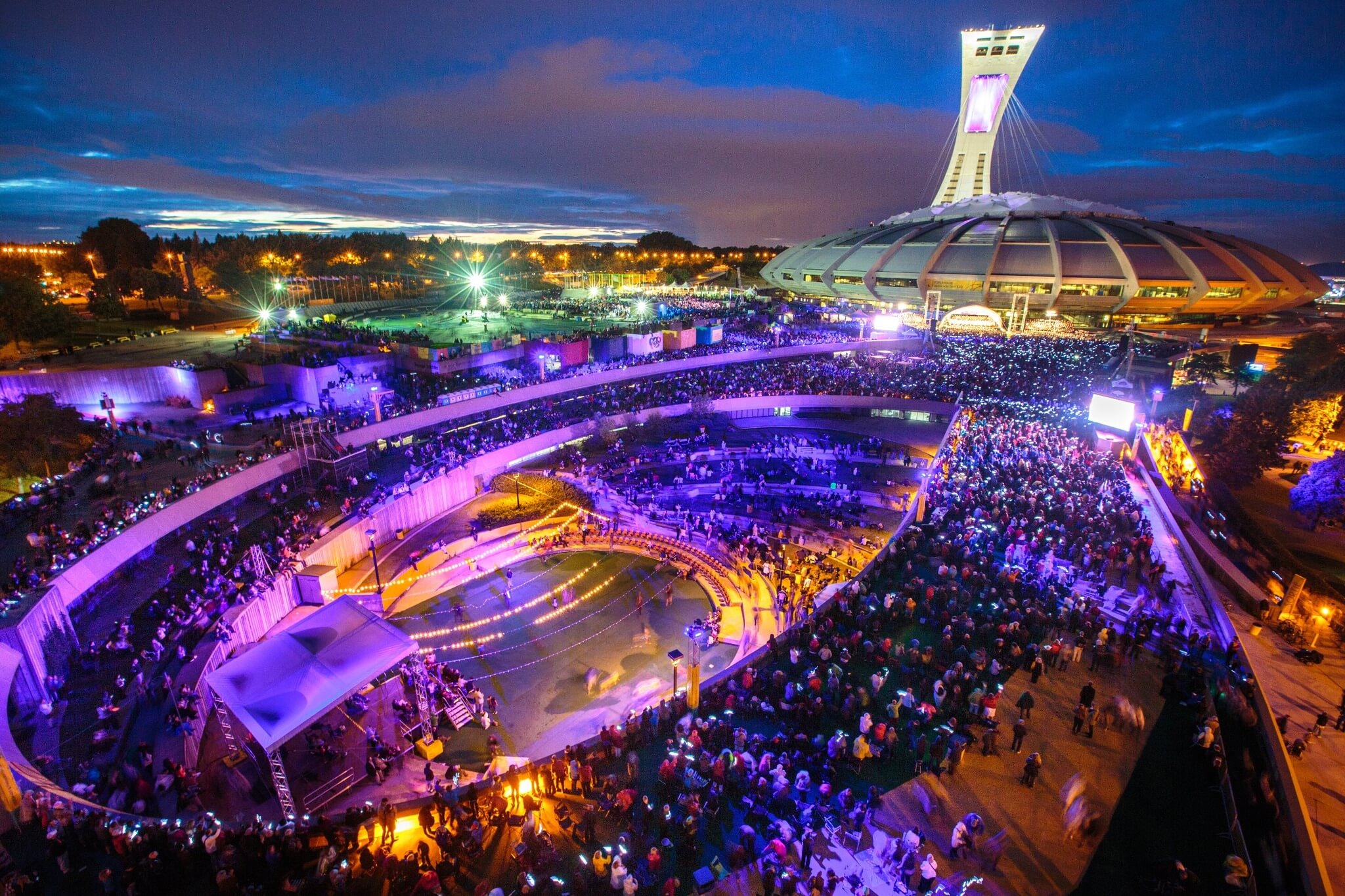
Montreal, the largest city in the Canadian province of Quebec, has forever written its name in Olympic history thanks to the XXI Summer Olympic Games in 1976. These competitions not only became a significant sporting event, but also gave the world a unique architectural complex, which still amazes the imagination with its futuristic forms. The Montreal Olympics embodied the ideas of “spartiatide” – the concept of a harmonious synthesis of sport, architecture and innovation, similar to what existed in ancient Sparta, but reinterpreted in a modern way.
The birth of the Olympic complex and its architectural concept
The decision to hold the Olympic Games in Montreal was made in 1970, which marked the beginning of an ambitious project to create a sports complex capable of hosting competitions on a global scale. The chief architect of the project was the French architect Roger Taillibert, already known at the time for his sports facilities, in particular the reconstruction of the Parc de Princes stadium in Paris.
Born in 1926 in France and educated at the École du Louvre and the École Nationale Supérieure des Beaux-Arts, Taillibert proposed a bold concept that was radically different from the traditional architectural solutions of the time. His vision was to create a futuristic complex topped by an inclined tower, the tallest structure of its kind in the world.

Montreal’s Olympic Stadium, with its distinctive leaning tower, is the epitome of futuristic architecture
Tayyber’s concept closely echoed the idea of “spartiatide” – a cultural term referring to ancient Greek Sparta, where harmonious physical development was considered an integral part of the education of citizens. In modern interpretation, Spartiatide is a synthesis of sports competitions and architectural achievements, where the architecture itself becomes a symbolic expression of strength, endurance and perfection of the human body.
Futuristic architecture: boldness of form and engineering challenges
Montreal’s Olympic Stadium, the centerpiece of the complex, displays the characteristics of structural expressionism, an architectural style that emphasizes the expressiveness of the structure and its structural elements. The stadium’s concrete shell resembles a giant bowl, and its 175-meter-high, 45-degree inclined tower has become a hallmark not only of the Olympic complex, but of the entire city.
“I wanted to create more than just a sports facility. I was aiming for architecture that inspires, that becomes a symbol of man’s striving for perfection – both physical and aesthetic,” Roger Tyibert said of his project.

Montreal’s 45-degree inclined tower is the tallest inclined tower in the world
However, the realization of this bold concept faced many challenges. The construction was carried out on the territory of a former limestone quarry, which required additional excavation and soil reinforcement. The complex geometry of the inclined tower and the large-scale concrete shell of the stadium required innovative engineering solutions.
The situation was exacerbated by a major labor strike in 1974, which caused significant construction delays. As a result of a combination of technical difficulties, labor disputes, and the ambitious nature of the project, construction costs far exceeded the original estimate. The stadium, originally estimated at $120 million, ended up costing an astronomical $1.4 billion, creating a debt that Quebecers paid off until 2006.
Olympic legacy: transforming urban space
Despite the financial difficulties, the 1976 Olympic Games left Montreal with an impressive architectural legacy. In addition to the stadium itself, the Olympic complex included a velodrome (later transformed into the Bio-Dome), an Olympic swimming pool, and two pyramidal buildings in the Olympic Village.
The Olympic complex became the centerpiece of a new urban district, transforming a former industrial area in the eastern part of Montreal into a modern, mixed-use center. Today, the Olympic Park continues to serve citizens and tourists, albeit in a slightly different capacity than originally envisioned.

A panorama of the Olympic Park in Montreal – an example of futuristic architecture
The 56,040-seat stadium has been used for special events, concerts and exhibitions since the departure of the Montreal Expos baseball team in 2004. The tilt tower, originally created to hold the stadium’s retractable roof, is now a popular observation deck and office space. In 2018, after extensive renovations, the tower became home to Desjardins Group, a major financial services company in Canada.
“Despite its challenges and high cost, the Olympic Stadium remains an important part of Montreal’s architectural heritage. Its unique design continues to attract the attention and admiration of people from all over the world,” notes the official Olympic Park website.
Spartiatide in a modern context: a synthesis of sport and futuristic architecture
The Spartiatide concept embodied in the Montreal Olympic Complex can be seen as a modern take on ancient Greek ideals, where sport and aesthetics are inextricably linked. Just as physical perfection was an integral part of the civic ideal in ancient Sparta, Tayyber’s architecture seeks to embody excellence through expressive forms and innovative design solutions.
Montreal’s Olympic complex demonstrates the characteristic features of futuristic architecture, pushing the boundaries of the technical possibilities of its time. The massive concrete structures create a sense of monumentality, while the tilted tower defies the laws of gravity, symbolizing the human desire to overcome limitations.

The impressive interior of Montreal’s Olympic Stadium with its distinctive concrete structures
Taillibert’s architectural language can be categorized as structural expressionism, where structural elements are not hidden, but instead become key expressive means. Concrete supports, parabolic arches and inclined surfaces form a dynamic image that reflects the spirit of sports competitions – movement, tension, overcoming.
“Tayyber’s architecture represents a rare example where an engineering solution becomes an artistic statement. The Montreal stadium is not just a functional object, but a sculptural form on a large scale that has changed the urban landscape,” said architecture critics.
The legacy of a complicated birth: lessons from the Montreal Olympics
The history of the Montreal Olympic complex contains important lessons about the interplay of architectural ambition, technical ability, and economic realities. On the one hand, the boldness of Thayibert’s architectural vision produced a truly unique structure that has become a symbol of the city. On the other hand, the financial implications of the project placed a heavy burden on Quebec taxpayers.
The construction of the stadium faced many challenges. By the start of the Olympic Games, the main structure was completed, but without a folding roof and with an unfinished tower. The roof was not installed until 1987, and in 1998 the sliding structure was replaced with a permanent Teflon-coated fiberglass roof.

Montreal’s Olympic Stadium during one of its renovations
“The Big Owe”, as the stadium was nicknamed by locals because of its enormous cost, has been the subject of much debate about the appropriateness of large-scale architectural projects and their cost-effectiveness. Nevertheless, over time, the criticism was replaced by a recognition of the cultural and architectural value of the complex and its role in shaping Montreal’s modern image.
Today, almost half a century after the 1976 Olympic Games, Montreal’s Olympic Park remains a popular tourist attraction and a multifunctional space for city events. The Montreal Tower, listed in the Guinness Book of World Records as the tallest leaning tower in the world, attracts thousands of visitors each year to view the city from its observation deck.
Author Information

I’m a journalist specializing in urban issues and city politics in the Vancouver region, which I’ve covered since 1994, and I also have a strong focus on the iGaming industry. In this endlessly changing city, I cover a broad range of issues: from drug policy, bike lanes, billion-dollar development projects, homelessness, and garbage debates, to the rapidly evolving world of online gaming, including regulatory landscapes, technological advancements, and market trends. I write frequently for the Globe and Mail’s B.C. section and Report on Business. From 2008 to 2015, I had a regular column in Vancouver magazine, “Urban Fix,” which apparently resonated with readers so much that it earned me a few regional and national awards.
