
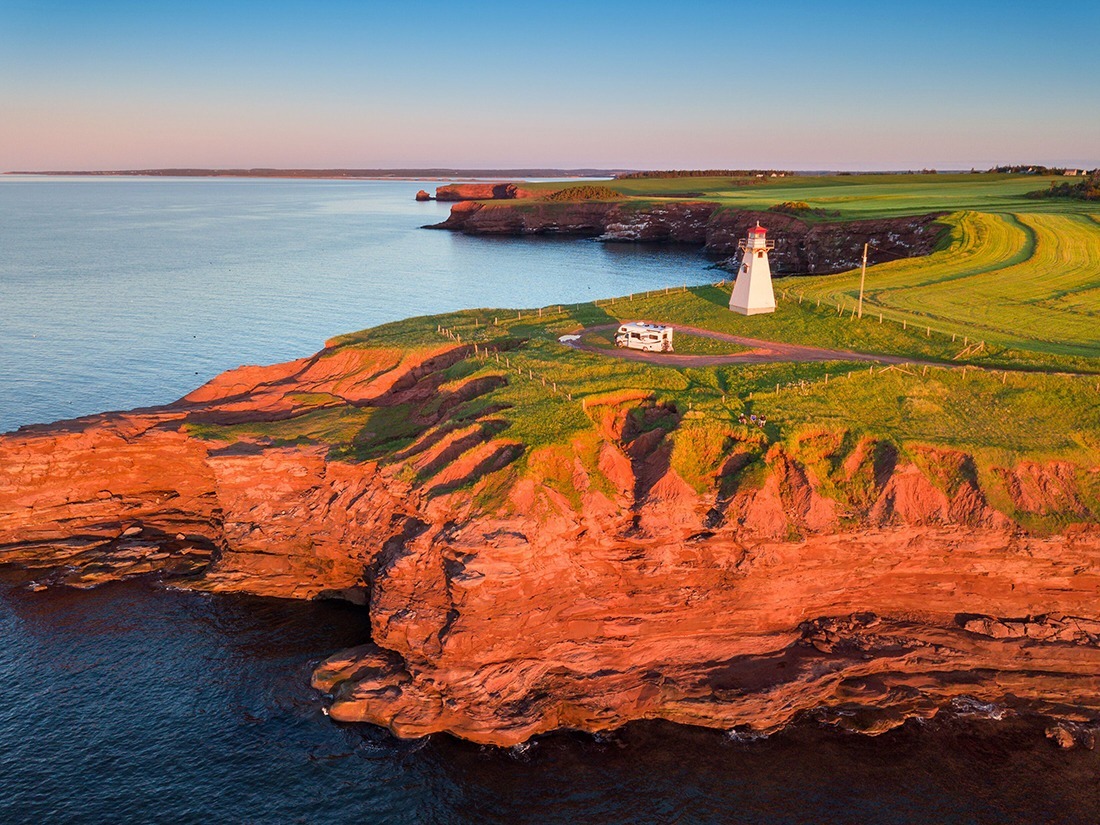
Lost off the east coast of Canada, in the sparkling waters of the Gulf of St. Lawrence, lies the amazing Prince Edward Island, a place that has forever entered the hearts of millions of readers through the work of Canadian author Lucy Maud Montgomery. This smallest of Canada’s provinces has become a true pilgrimage destination for those in love with the story of red-haired orphan girl Anna Shirley, the protagonist of the novel Anne of Green Roofs.
The jewel of Eastern Canada
Prince Edward Island (abbreviated OPE or PEI) is a province located in eastern Canada in the Gulf of St. Lawrence. Despite its modest size (only about 5,660 km²), this island has truly unique natural features that make it one of the most picturesque places in North America.
The island’s trademark is its famous red soil, which gives the island’s landscapes an amazing contrast: scarlet fields and roads against emerald green meadows and turquoise sea. This unusual coloration of the soil is due to the high content of iron oxide (rust) in the soil. The red color of the soil is also reflected in the island’s beaches – many of them are covered with sand in various shades of red: from pale pink to rich brick.

The landscape of the island consists of gently rolling hills with farmland, small forests and numerous bays. The coastline is indented so that no point on the island is further than 16 kilometers from the sea. This proximity to the ocean determines the temperate maritime climate – extreme temperatures in both winter and summer are rare here.
Lucy Maud Montgomery: creator of a magical world
It was in this picturesque setting that on November 30, 1874, in a small house in Clifton (now New London), Lucy Maud Montgomery was born – a woman whose name is inextricably linked to Prince Edward Island thanks to the literary masterpiece she created.
Montgomery’s biography is full of drama: having lost her mother in early childhood, she was brought up by her grandparents in Cavendish. This period of her life had a huge influence on her work – the rural setting, proximity to nature and the company of elderly guardians formed the basis of the plot of her most famous work.
Although Lucy Maud Montgomery wrote many books, she is best known for her novel Anne of Green Roofs (other translations include Anya of Green Mezzanines or Anne of Green Roofs), first published in 1908. The book gained instant popularity and was translated into dozens of languages.

Interesting fact: according to some modern studies, Lucy Maud Montgomery herself could have ADHD (Attention Deficit Hyperactivity Disorder), which was reflected in the character of the heroine she created – Anne Shirley. Her dreaminess, tendency to fantasize, vivid emotional reactions, and endless curiosity may have been a reflection of the author’s own personality.
“Green Roofs”: between fiction and reality
The events of the novel “Anne of Green Roofs” take place in the fictional town of Avonlea, the prototype of which served as a real Cavendish – a small settlement on the north coast of the island. The center of the narrative is the farm “Green Gables” (Green Gables), where the main character – 11-year-old orphan Anna Shirley.
The story of the creation of the novel is closely connected with real places and people from Montgomery’s life. The house that became the prototype of Green Gables Farm really existed – it was a farm owned by the writer’s cousins, David and Margaret MacNeil. Today, the house, built between 1831 and the 1870s, has become one of the island’s top tourist attractions.

Remarkably, Montgomery herself never lived in the house, but knew it well, often visiting there. The surrounding landscapes – hills, forests, gardens, and streams – are reflected in the descriptions of nature in the novel. Many of the places mentioned in the book, such as Haunted Wood and Lovers Lane, also existed in reality and were the writer’s favorite places to walk.
In Anne’s Footsteps: A Literary Journey
Today, Prince Edward Island offers a unique opportunity to immerse oneself in the world of Anne of Green Roofs through the many sites associated with the novel and its author. This literary tourism has become an important element of the island’s economy, attracting thousands of book fans from around the world each year, especially from Japan, where works about the red-haired girl are incredibly popular.
Green Gables Heritage Place
Central to the island’s “literary” tourism is Green Gables Heritage Place, a National Historic Site located in Cavendish in Prince Edward Island National Park. Here you can visit:
- The Green Gables House, restored and furnished in late 19th century style, exactly as described in the book. Visitors can see Anne’s bedroom, Marilla’s kitchen, and other rooms familiar to readers.
- A modern visitor’s center with interactive exhibits about the life and work of Lucy Maud Montgomery, the life of the time, and the novel’s impact on culture.
- Picturesque trails through the very places that inspired the writer: “The Enchanted Forest” and “Lovers’ Alley” invite visitors to walk the same paths as the literary characters.
Lucy Maud Montgomery House Museum in Cavendish
Not far from Green Roofs is the site where Montgomery’s grandparents’ house once stood, where the writer spent much of her childhood. Although the house itself has not survived, there is an outdoor museum where you can see the house’s foundation, garden, and other elements related to the writer’s life.
Lucy Maud Montgomery’s birthplace
In New London (formerly Clifton), you can visit the small house where the writer was born. This modest structure has been turned into a museum that tells the story of Montgomery’s childhood and the beginning of her literary journey.
Anne of Green Gables Museum
Park Corner is home to another important site for fans of the novel, the Anne of Green Gables Museum, located in the house known as Silver Bush. This house belonged to Montgomery’s cousins, the Campbell family, and it was here that the writer held her wedding in 1911.
The museum displays Lucy Maud Montgomery’s personal effects, first editions of her books, and the surrounding landscape with the “Lake of Shining Waters” described in the novel.

The novel’s influence on modern culture
The impact of Anne of Green Roofs on Prince Edward Island’s culture and tourism cannot be overemphasized. Every year, thousands of tourists come here precisely because of this book. Charlottetown, the provincial capital, regularly stages the musical Anne of Green Roofs, which has become one of Canada’s longest-running theatrical productions.
The image of Anne of Shirley has become a symbol of the island, and her red pigtails can be seen on numerous souvenirs, from dolls to hats with braids attached. Cavendish has even created a themed Avonlea Village, a reconstruction of a fictional town with historic buildings, stores and activities that immerse visitors in the book’s atmosphere.
Modern tourism on the island
In addition to the literary attractions associated with “Anne of Green Roofs,” Prince Edward Island attracts tourists with its beautiful scenery, beaches and gastronomic features:
- Prince Edward Island National Park with its long sandy beaches, dunes and eco-trails.
- Beautiful lighthouses scattered around the perimeter of the island, many of which have historical significance.
- Seafood, especially the island’s world famous mussels and oysters, as well as fresh fish and local cheeses.
- Potato farms – the island is famous for its potatoes due to its fertile red soil.
Journey into the world of literary classics
A visit to Prince Edward Island is not just a tourist trip, it is a real literary pilgrimage, an opportunity to walk in the footsteps of your favorite characters and their creator. Here, every landscape, every house and every path seems to have stepped off the pages of a book, allowing visitors to feel part of the magical world that Lucy Maud Montgomery created over a century ago.
Whether you’re a longtime fan of Anne of Green Roofs or just discovering the story, Prince Edward Island will welcome you with its red roads, green fields and blue sea, creating a unique atmosphere where reality and literary fiction intertwine in the most amazing ways.
As Lucy Maud Montgomery herself wrote: “I think the Island is the most beautiful place on earth. I am always glad I was born here. Nowhere else are there such red roads, such vivid shades of green, such blue of sea.”
And though times change, the island continues to hold the same spirit of charm and imagination that once inspired a humble village teacher to write one of her favorite books of all time.
Coming to Prince Edward Island, everyone can become Anna Shirley for a while – dreamy, impressionable and full of admiration for the world around her. And perhaps that is the secret to the enduring popularity of both the book and the place that inspired it.
Author Information

I’m a journalist specializing in urban issues and city politics in the Vancouver region, which I’ve covered since 1994, and I also have a strong focus on the iGaming industry. In this endlessly changing city, I cover a broad range of issues: from drug policy, bike lanes, billion-dollar development projects, homelessness, and garbage debates, to the rapidly evolving world of online gaming, including regulatory landscapes, technological advancements, and market trends. I write frequently for the Globe and Mail’s B.C. section and Report on Business. From 2008 to 2015, I had a regular column in Vancouver magazine, “Urban Fix,” which apparently resonated with readers so much that it earned me a few regional and national awards.
