
Introduction
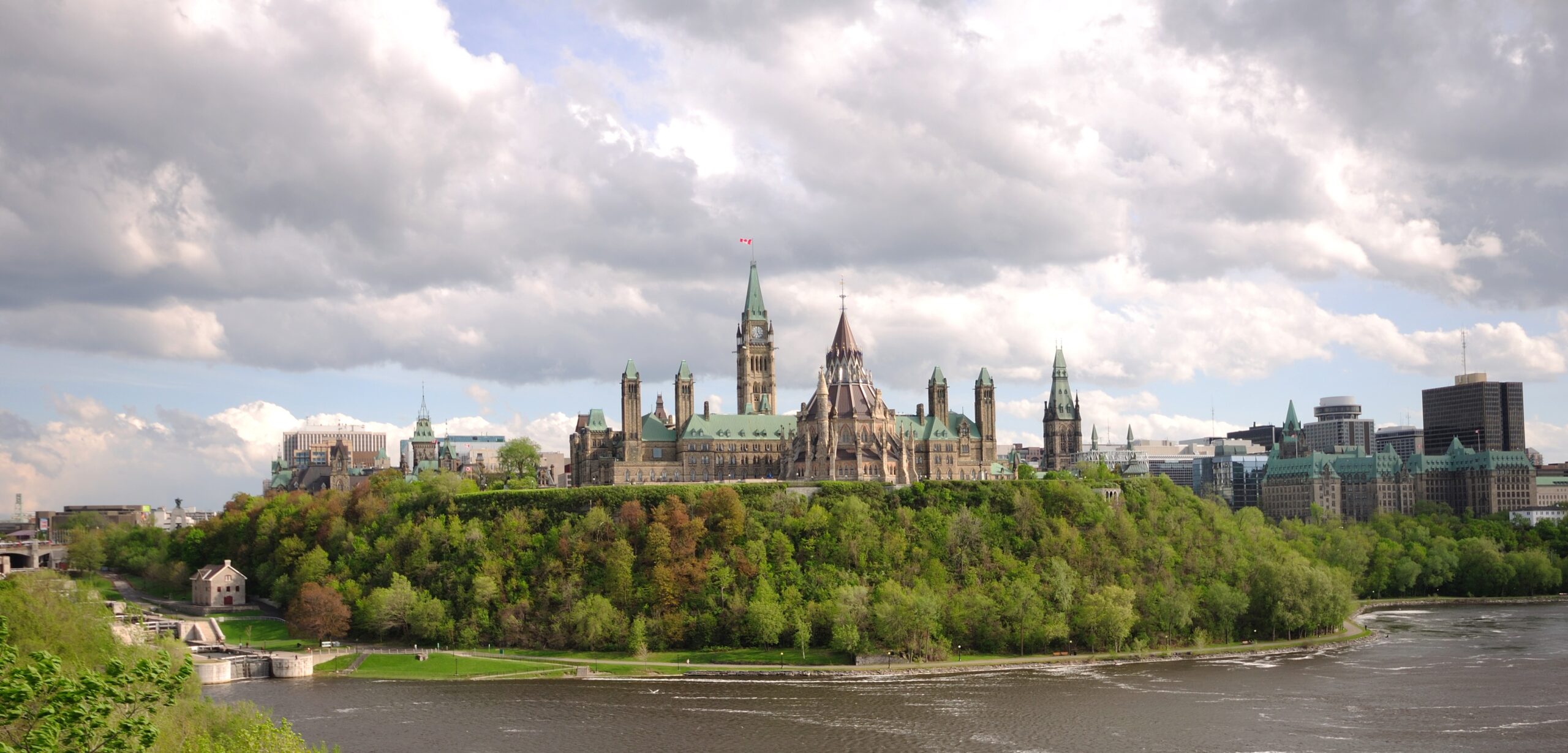
Overlooking the waters of the Ottawa River, a majestic complex of gray stone buildings with pointed towers and green roofs is Parliament Hill, or, as it is more commonly referred to by locals, simply “The Hill”. Home to Canada’s highest legislative body, it is not just the administrative center of the country, but the true embodiment of Canadian statehood, democracy and national identity. Every year, about three million tourists and residents climb the hill to see for themselves the place where Canadian history is made, laws are passed and the destiny of the state is decided.
Parliament Hill is a 9-hectare parcel of crown land on the south bank of the Ottawa River in the center of Canada’s capital. It is home to a complex of neo-Gothic buildings that house the Parliament of Canada, a bicameral legislature consisting of the Senate and the House of Commons. Parliament Hill also serves as the site of major state ceremonies, national holidays and is the symbolic center of Canadian democracy.
From military post to the heart of the nation: the history of Parliament Hill
Early history of the area
The history of the area where Parliament Hill stands today dates back to ancient times. For hundreds of years, the limestone ledge on which the modern Parliament Hill complex sits served as a landmark on the Ottawa River for Indigenous peoples and later for European traders, travelers and industrialists, marking their way to the interior of the continent.
The hill was originally covered with an ancient forest of beech and ash trees. After the founding of Ottawa, then called Baytown, the builders of the Rideau Canal placed a military base on the hill, naming it Barrack Hill (Barracks Hill). After the Anglo-American War of 1812-1814 and the Upper Canada Rebellion, a large fort was planned to be built here, but the threat of American invasion diminished and the project was canceled.
Choosing a site for Parliament
A major turning point in the history of Parliament Hill was in 1858 when Queen Victoria chose Ottawa as the capital of the Province of Canada. Barrack Hill was chosen as the site for the new Parliament buildings because of its favorable position above the city and the river, and because the Crown already owned the land.
on May 7, 1859, the Department of Public Works issued a competition for designs for new Parliament Buildings on Barrack Hill, which received 298 applications. The number of applicants was reduced to three, but the jury could not decide whose design should win. Governor-General Sir Edmund Walker Head was approached to resolve the stalemate and the winners were announced on August 29, 1859.
Construction of Parliament
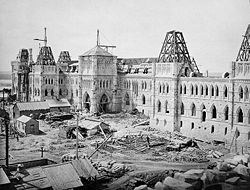
Construction can be considered to have begun on December 20, 1859, when the foundation stone was laid. The first stones were laid on April 16 the following year, and on September 1, 1860, Prince Albert Edward, Prince of Wales (later King Edward VII) laid the cornerstone of the Central Block.
The construction of Parliament Hill was the largest building project undertaken in North America at the time. The builders faced a number of challenges: they encountered rock earlier than expected, requiring blasting to complete the foundations, which the architects modified to sit 5.2 meters deeper than originally planned. By early 1861, Public Works Canada reported more than $1.4 million in project costs, which led to the construction site closing in September and covering the unfinished structures with tarps until 1863, when construction resumed after a commission of inquiry.
The construction site was still incomplete when, in 1867, the three British North American colonies (now the provinces of Ontario, Quebec, Nova Scotia and New Brunswick) joined Confederation, leaving Ottawa as the capital of the new country. Within four years, Manitoba, British Columbia, Prince Edward Island, and the Northwest Territories joined, which, along with the attendant bureaucracy, necessitated increased representation in Parliament. Parliamentary offices expanded to buildings outside Parliament Hill.
By 1876, the Parliament Hill buildings and the surrounding fence and gates were completed. The area was designed with the help of architects Thomas Scott and Calvert Vaux.
Fire and rebuilding
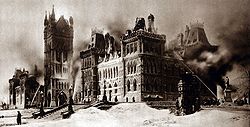
on February 3, 1916, a fire destroyed the Central Block of Parliament. Despite the ongoing First World War, the Governor General, Prince Arthur, Duke of Connaught, re-laid the original cornerstone on September 1, 1916, exactly fifty-six years after his brother, the future King Edward VII, first laid it.
Eleven years later, the restored Central Block was completed, and the new freestanding bell tower was dedicated as the Peace Tower in memory of Canadians who died in the First World War. The new Centre Block was intended as a memorial to Canadians who fought in the First World War, and therefore expressed a stronger sense of Canadian identity through its design.
Architectural Features of Parliament Hill
Neo-Gothic style and symbolism
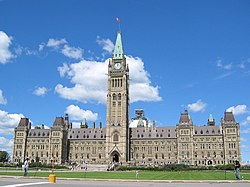
The architectural style of parliamentary buildings is Neo-Gothic, reflecting the grand and rich history of British parliamentary democracy. The choice of Gothic Revival over the neoclassical style typical of Washington, D.C. (USA) was made deliberately to emphasize the connection with European democratic traditions and to contrast with the republican institutions of its southern neighbor.
The Parliament Buildings are excellent examples of the highly developed Victorian Gothic Revival. This was the most successful of the medieval revival styles of the time. It was also thought that this style would better suit the harsh surroundings of the still wild northern North American countryside, while maintaining grandeur.
The main buildings of the complex
The Parliament Buildings are three structures arranged around three sides of the central lawn of Parliament Hill. The Speakers of each House of the Legislature oversee the use and management of space in each building.
- Center Block – houses the Senate and House of Commons chambers, is adorned with the Peace Tower on the south façade, and the Library of Parliament is located at the rear of the building. Inside the Centre Block is the “Red Room” for the Senate and the “Green Room” for the House of Commons.
- East Block – contains the offices of Ministers and Senators, meeting rooms and other administrative offices.
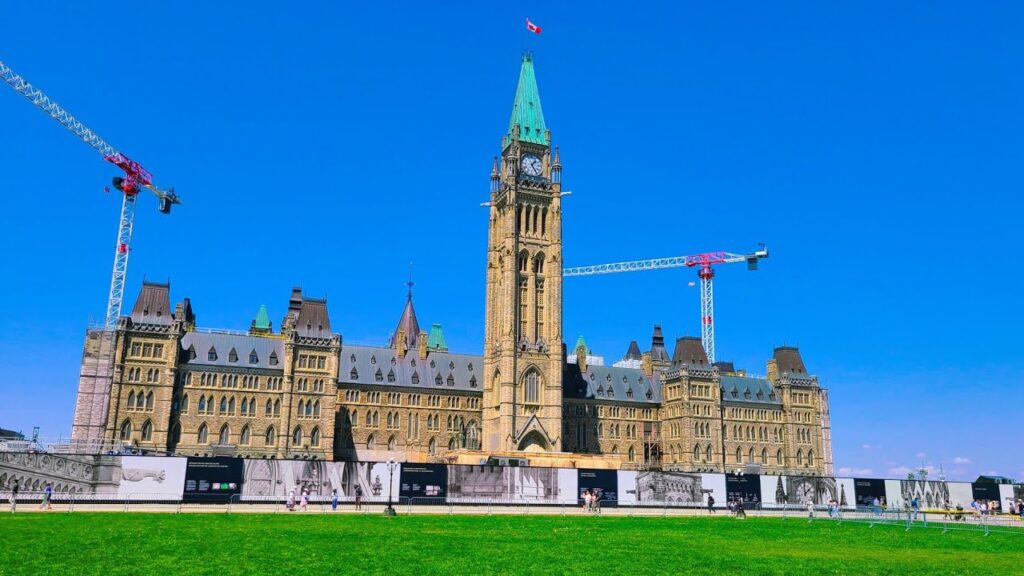
- West Block – currently serves as a temporary meeting place for the House of Commons while the Central Block is being renovated.
Peace Tower and Library of Parliament
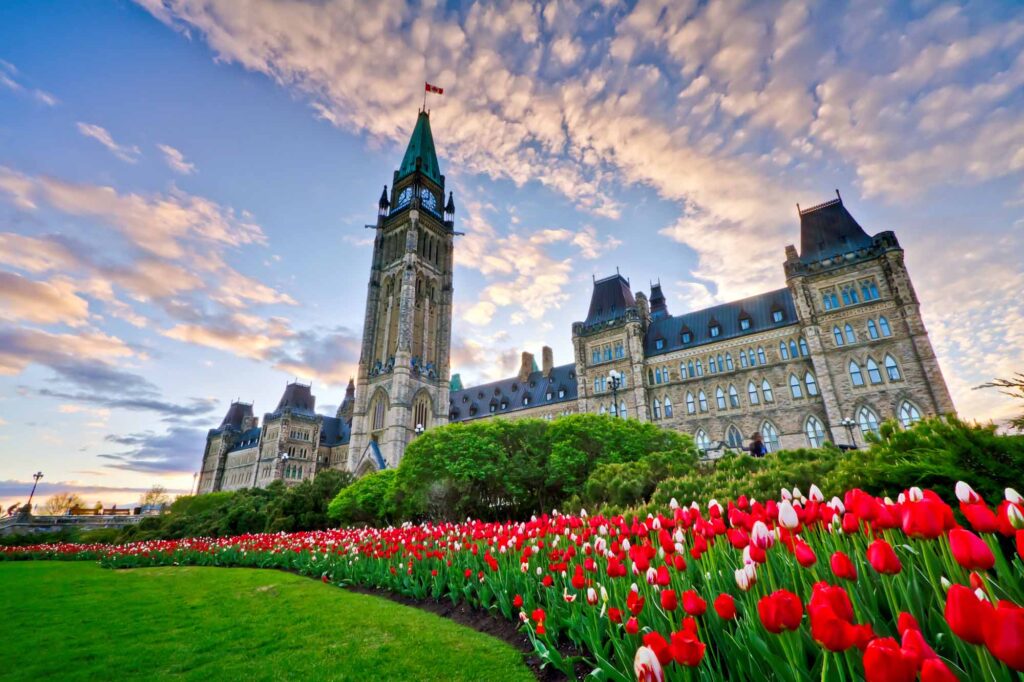
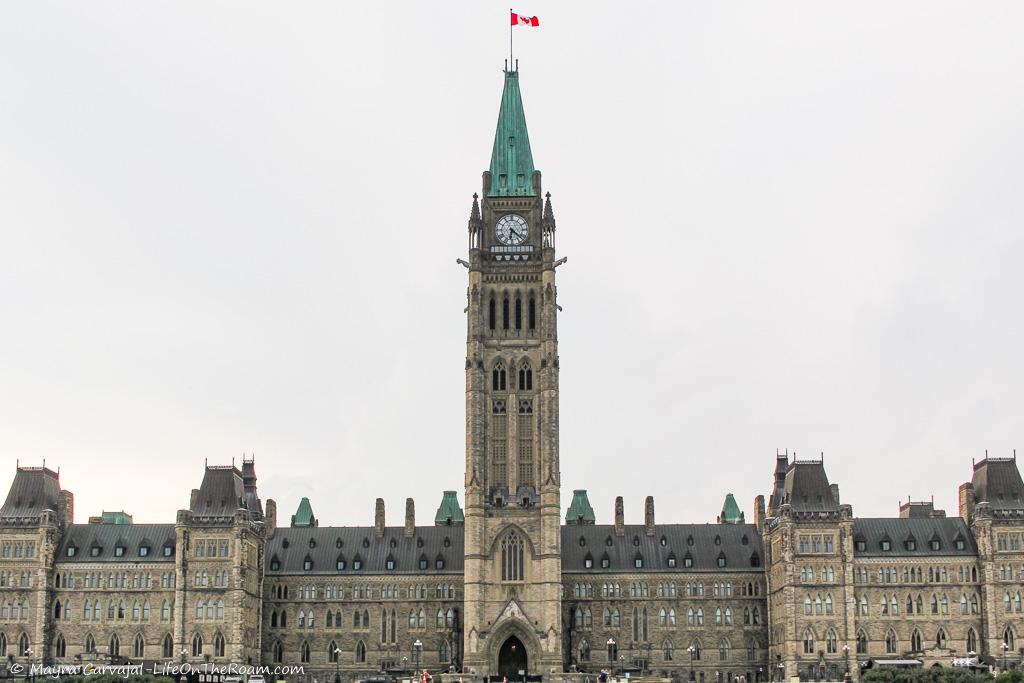
ThePeace Tower, the tallest part of the parliamentary complex, is a memorial to Canadians who died on the battlefields of Europe during the First World War. It was built to replace the Victoria Tower, which was destroyed in a fire. Standing 92.2 meters tall, it is one of the most recognizable symbols of Canada.
Library of Parliament – Located in a circular building above the Ottawa River,theLibrary of Parliament is the only part of the original Centre Block to survive the 1916 fire. Built in a polygon shape in the Victorian Gothic style, the library is a magnificent example of 19th century architecture and contains an extensive collection of books and documents.
Special rooms and halls
Confederation Hall – the most spacious of all parliamentary rooms, also known as the Hall of Two Hundred, after the number of Members of Parliament.
TheMemorial Chamber of Parliament is a special room where on a pedestal rests a bulky book that records the names of all Canadians who died in Europe on the fields of the First and Second World Wars.
Parliament Hill in Canada’s political system
Constitutional monarchy and parliamentary democracy
Canada is a constitutional monarchy and parliamentary democracy based on the British Westminster tradition. The political system has three main components: the Crown (the monarch), the Senate, and the House of Commons.
The Parliament of Canada consists of the monarch (represented by the Governor General), appointed senators, and elected members of the House of Commons. The consent of all three components of Parliament is required for a law to be passed. Because Canada is a federal state, the responsibility for lawmaking is divided among the federal, ten provincial and three territorial governments.
Structure and functions of Parliament
TheSenate is the upper house of Parliament, consisting of 105 senators appointed by the Governor General on the advice of the Prime Minister. Senators represent Canada’s regions, provinces and territories.
TheHouse of Commons is the lower house, consisting of 343 members elected by Canadians to represent certain constituencies.
Executive Power and the Principle of Responsible Government
Executive power in Canada is vested in the Crown and is exercised by the Governor General in Council – the Prime Minister and Cabinet. Once appointed, the Prime Minister selects a number of advisors, usually from among elected members of Parliament belonging to the ruling party, who become members of the Privy Council and are sworn in as ministers. Together they make up the cabinet and are responsible for individual portfolios or departments.
Canada’s parliamentary system requires government to be accountable to citizens and to act responsibly. Cabinet ministers are both individually responsible to Parliament for exercising their authority as heads of departments and collectively responsible for all cabinet decisions.
By constitutional convention, the Prime Minister and Cabinet can only continue to exercise power with the consent and approval of a majority of the House of Commons. If the government is defeated in the House of Commons on a confidence motion, the Prime Minister is expected to resign or seek the dissolution of Parliament for a general election.
The role of political parties
Political parties are organizations that bring together a group of people committed to a particular approach to governance and pursuing common goals based on a shared vision. The majority of MPs belong to a political party.
To qualify as a “recognized party”, a political party must have at least 12 elected members in the House of Commons. Opposition parties lead and focus on the representative and scrutiny functions of MPs. They work to ensure that legislation is scrutinized and that different views on important initiatives are publicly expressed and defended.
Cultural and symbolic significance of Parliament Hill
National ceremonies and events
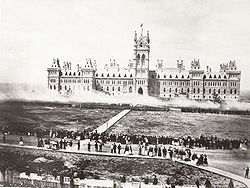
Parliament Hill serves not only as a place for lawmaking, but also as a center for important national events and ceremonies. The main open area is the formal front yard formed by the arrangement of parliamentary and departmental buildings. This area is used for major celebrations, demonstrations and traditional performances such as the annual Canada Day celebrations and changing of the guard ceremonies.
Of special significance is Parliament Square, where the Centennial Flame, lit in 1967 to mark the centennial of Canadian Confederation and a symbol of the country’s unity, burns surrounded by the emblems of the Canadian provinces.
Monuments and statues on the grounds
Parliament Hill is home to more than 20 bronze statues commemorating important figures in Canadian history. Most of them are located in the gardens behind the three parliamentary buildings. Among the most significant:
- The Statue of Queen Victoria, erected in 1901 and dedicated to Canada’s first monarch
- Monument to Sir John A. Macdonald, Canada’s first prime minister
- Statues of Robert Baldwin and Louis-Hippolyte Lafontaine, champions of responsible government
- A memorial to the Famous Five, a group of women who achieved the recognition of women as “persons” under the law
- Sir Galahad Statue, the only statue not of a monarch or politician, erected in memory of Henry Albert Harper, who drowned while trying to rescue a girl who had fallen through the ice on the Ottawa River
Historical events associated with the hill
Parliament Hill has witnessed several significant events in Canadian history:
- The first visit of the reigning Canadian sovereign King George VI and his wife Queen Elizabeth to their Parliament in 1939
- The massive celebration of Victory Day in Europe on May 8, 1945
- First hoisting of Canada’s new national flag on February 15, 1965
- Queen Elizabeth II’s visit on April 17, 1982 to issue a royal proclamation to bring into force that year’s Constitution Act
Sadly, the hill has also been the site of tragic events, including the terrorist attack on October 22, 2014, when an armed gunman killed a Canadian soldier carrying a ceremonial guard at the National War Memorial and then infiltrated the Central Block of Parliament Buildings.
Tourist significance and visitor accessibility
Visiting Parliament Hill
Approximately three million tourists visit Parliament Hill each year, making it one of Canada’s top attractions. Visitors can take part in free tours of the Houses of Parliament, although access may be limited during parliamentary sessions.
Tours of the House of Commons are available in the West Block, while tours of the East Block are available from July through early September. The public entrance is located in the new Visitor Center, between the Central and West Blocks buildings.
Changing of the guard and other ceremonies
One of the most popular spectacles for tourists is the Changing of the Guard ceremony, which takes place daily in the morning during the summer months. The ceremonial guard consists of soldiers in traditional red uniforms and tall bear hats, reflecting British military traditions.
In addition, from the end of June through the end of August, the regimental bands of the Ceremonial Guard perform a free concert daily from 10:00 to 10:30.
Modern renovations and the future of the complex
Since 2002, Parliament Hill has been undergoing a massive $3 billion renovation and modernization project. The project is to bring the parliamentary buildings up to modern safety standards and address their dilapidated condition. The work is expected to be completed after 2028.
The West Block was completed in November 2018, after which the House of Commons moved there, and the renovation of the Senate of Canada Building was completed in 2019 to house the Senate while the Central and East Blocks undergo renovations.
Parliament Hill as a symbol of Canadian identity
In 1976, the Parliament Buildings and the grounds of Parliament Hill were recognized as National Historic Places of Canada due to their importance as a physical embodiment of the Canadian government and as a center for national celebrations.
Parliament Hill is much more than just a seat of government. It is the symbolic heart of the Canadian nation, a place of meetings, celebrations and visits. Here, representatives from across Canada gather to pass laws that affect the lives of every Canadian.
The architecture of the complex, which combines neo-Gothic elements with symbols of Canadian nature and history, creates a unique space that serves not only functional purposes but also expresses the values of Canadian society: respect for tradition while always striving for progress, openness and democracy while maintaining order and stability.
At the same time, Parliament Hill is a living, evolving space that reflects the evolution of Canadian democracy and national identity. Each generation of Canadians contributes to its history, while remaining connected to the past and looking to the future.
Conclusion
Parliament Hill in Ottawa is central to both the geographic and symbolic landscape of Canada. Its grand neo-Gothic buildings, which have survived fires, wars and political upheaval, continue to serve as the home of Canadian democracy and the place where decisions are made that shape the nation’s future.
The combination of historical significance, architectural beauty and political importance makes Parliament Hill a unique place worthy of its status as a national symbol. It is a space where Canadians can see their past, feel the pulse of the present and think about the future of their country.
For millions of Canadians and visitors, Parliament Hill remains not just a tourist attraction, but a living embodiment of the democratic ideals on which Canada was built. In every stone of its buildings, in every ceremony on its lawns, in every sitting of its Parliament, the history and spirit of the Canadian people is reflected.

The influence of British traditions on Canadian parliamentarianism
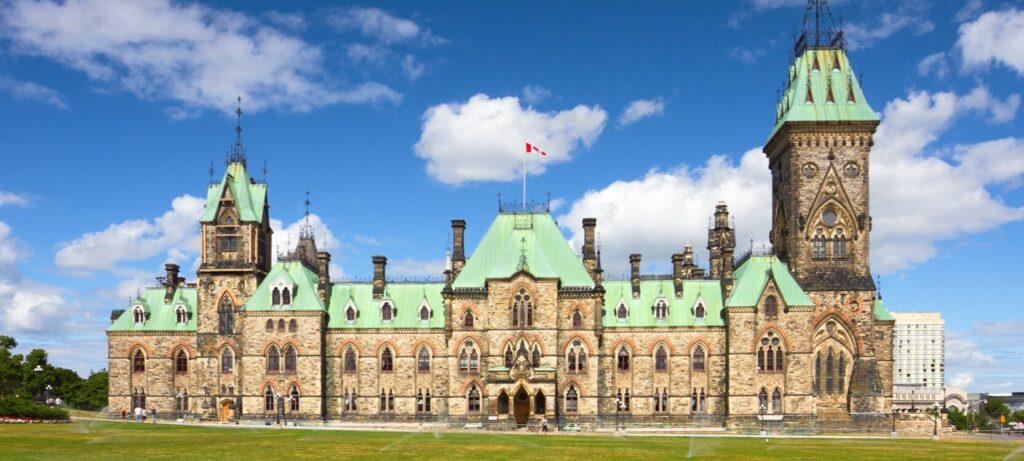
British heritage in Canadian parliamentary traditions
The Canadian parliamentary system is deeply rooted in British traditions, which is reflected not only in the architecture of Parliament Hill, but also in political procedures and ceremonies. As in the UK, the Canadian Parliament features the figure of the Speaker, who is the neutral presiding officer of the House. The Speakers of the Senate and House of Commons wear black robes and have ceremonial rods to symbolize their authority.
Another borrowed tradition is Question Period, a daily session in the House of Commons when members of the Opposition can ask questions of the Prime Minister and cabinet ministers. It is an essential tool of parliamentary control over the executive branch, bringing transparency to the process of governance.
Bilingualism in parliamentary processes
A unique feature of Canadian parliamentarianism is official bilingualism – work is conducted in both English and French. On Parliament Hill, all inscriptions, signs, official documents and parliamentary debates are in both languages. Members of Parliament can speak in either of the official languages, and simultaneous interpretation is provided for all meetings. The name of the hill itself – Parliament Hill / Colline du Parlement – reflects this duality.
This linguistic duality symbolizes a fundamental principle of Canadian federalism – respect for the country’s cultural and linguistic diversity, which is particularly important for French-speaking Quebec and the country’s scattered francophone communities.
Parliament Hill’s work in the twenty-first century
Contemporary challenges and technological innovation
In the twenty-first century, Parliament Hill faces the need to adapt to new realities. The COVID-19 pandemic caused unprecedented changes in the way Parliament works – hybrid sessions were introduced, allowing parliamentarians to participate remotely via videoconferencing. Much of parliamentary debates and committee meetings are now streamed online, making the work of legislators more accessible to citizens.
The ongoing major renovation of parliamentary buildings also includes the modernization of technical infrastructure. Modern security systems, information technology and environmentally friendly solutions are being installed in the renovated buildings to make the historic buildings fit for the 21st century while preserving their historical value.
Security and openness: the search for balance
Following the tragic events of October 2014, when an armed man attacked the National War Memorial and infiltrated the Central Block of Parliament, security measures on Parliament Hill were significantly strengthened. A Parliamentary Protective Service was created, combining House of Commons and Senate security with Royal Canadian Mounted Police patrols.
In doing so, the Canadian authorities strive to maintain a balance between providing security and keeping Parliament open to citizens. Parliament Hill remains accessible to the public and continues to be a venue for public meetings and demonstrations – symbolizing Canadian democracy’s commitment to openness and freedom of expression.
The role of Parliament Hill in Canada’s constitutional development

From colonial status to full sovereignty
Parliament Hill has witnessed Canada’s gradual evolution from a British colony to a fully sovereign nation. When the original buildings were constructed in the 1860s, Canada was just a British colony. In 1867, with the passage of the British North America Act (now known as the Constitution Act of 1867), the Canadian Confederation was created, uniting the four colonies into a new dominion.
The Statute of Westminster of 1931, passed by the British Parliament, granted Canada legislative independence, an important step toward full sovereignty. However, it was not until 1982, when Queen Elizabeth II signed the Constitution Act on Parliament Hill, that Canada gained full independence to change its constitution without recourse to the British Parliament.
Role in Canada’s federal system
Parliament Hill symbolizes not only the federal government, but the entire Canadian federal system. The coat of arms of each province and territory is displayed on the hill, and provincial and territorial flags fly alongside the national flag, emphasizing the unity of the country in its diversity.
Inside the walls of the parliamentary buildings, key debates about federal-provincial relations, the distribution of powers and resources, and national unity take place. The history of Parliament Hill is closely tied to the evolution of Canadian federalism, from the original union of four provinces to the current ten provinces and three territories.
Cultural features of Parliament Hill
Seasonal changes and events on the hill
Parliament Hill is a place that transforms with each season, offering visitors new experiences year-round. In summer, the area around the parliamentary buildings turns into a blooming garden with thousands of tulips and other flowers, creating a striking contrast to the gray stone of the buildings.
In winter, the hill is covered with snow, and the parliament buildings, illuminated at night, create a magical winter scene. Every December, a large Christmas tree is placed on the hill and is ceremoniously decorated and lit during the Christmas Lights Across Canada ceremony.
A special event is the annual Northern Lights light and sound show, which is projected onto the facade of the Central Block of Parliament during the summer months, telling Canada’s story through impressive visuals.
Art and cultural treasures in the Parliament Buildings
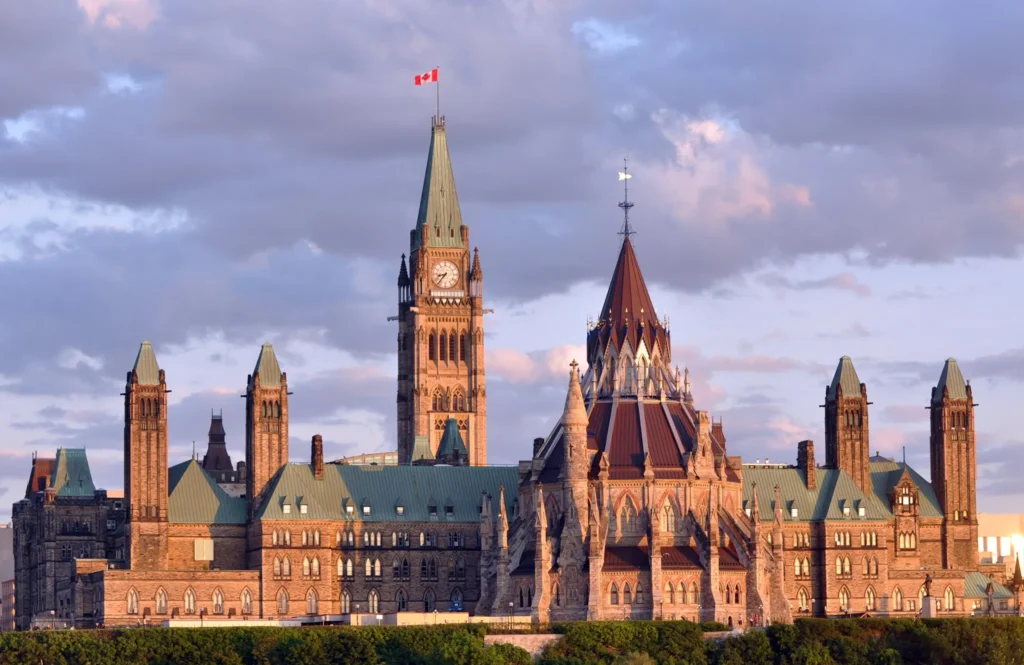
The interior of the Parliament Buildings is a treasure trove of Canadian art. The walls are decorated with numerous paintings depicting important moments in Canadian history, portraits of monarchs and prominent political figures.
In the buildings you can find many sculptures and wood and stone carvings made by Canadian artists. The Memorial Chamber, with its carved stone arches, stained glass windows and central altar that houses the Book of Remembrance with the names of fallen Canadians, is particularly notable.
The Library of Parliament, which survived the 1916 fire, is an architectural and cultural masterpiece. Its circular hall with its high dome, carved wood panels and galleries contains more than 600,000 books and is a magnificent example of Victorian interior design.
Ceremonial traditions
Many ceremonies held on Parliament Hill have deep historical roots and reflect Canada’s constitutional monarchy. Among them:
- Speech from the Throne: the traditional opening of a new session of Parliament, when the Governor General (the monarch’s representative) reads a speech to the Senate outlining the government’s program.
- Royal Assent Ceremony: the act by which the Governor General gives final approval to bills that have passed through both houses of Parliament, turning them into laws.
- Remembrance Day wreath-laying ceremony: on November 11 each year, when Canadians gather at the National War Memorial (near Parliament Hill) to remember Canadian soldiers killedinwars.
Parliament Hill and the Indigenous Peoples of Canada
Recognizing territorial rights and reconciliation
In recent decades, Parliament Hill has been the site of important events related to the recognition of Indigenous rights and the reconciliation process. Increasingly, official events on the Hill have begun by recognizing that Parliament is located on the traditional, never ceded territory of the Algonquin people.
In 2008, then-Prime Minister Stephen Harper delivered a landmark official apology to former Indigenous residential school students, recognizing the government’s role in creating a system that has caused irreparable harm to generations of Indigenous people.
Indigenous representation in Parliament
Indigenous representation in the Canadian Parliament has increased significantly in recent years. In 1992, Elijah Harper, a Cree MP, played a key role in blocking the Meech Accord by holding an eagle feather in protest. It was a symbolic moment that showed the growing political power of Indigenous peoples in Canada.
Today, traditional Indigenous ceremonies are increasingly seen on Parliament Hill, and Indigenous flags and symbols are gradually becoming an integral part of official ceremonies, reflecting the country’s efforts to build a more inclusive and respectful society.
Parliament Hill in Canadian media and popular culture
Symbolic significance in national identity
The image of Parliament Hill has become one of Canada’s most recognizable symbols, along with the maple leaf and the Canadian flag. Images of parliamentary buildings, especially the Peace Tower, are found on Canadian money, postage stamps, and official documents. These images have become visual anchors for national identity.
In Canadian history and civics textbooks, Parliament Hill is often used to illustrate the principles of democracy and parliamentarism. Many schoolchildren visit Parliament every year as part of their civic education.
Parliament Hill in popular culture
The majestic buildings of Parliament Hill serve as the backdrop for many Canadian films and television programs, especially those with political themes. Daily news programs usually include live coverage of Parliament Hill, emphasizing its role as the center of the country’s political life.
In literature and art, Parliament Hill often becomes a metaphor for Canadian politics in general. Mordecai Richler, Margaret Atwood, and other famous Canadian writers have incorporated Parliamentary intrigue and scenery into their works.
Environmental initiatives on Parliament Hill
The modern approach to managing the Parliament Hill area includes serious attention to environmental sustainability. The National Capital Commission, which is responsible for the maintenance of the grounds, is implementing environmentally-oriented landscaping and natural resource management practices.
Major renovations to parliamentary buildings include the installation of energy-efficient heating and cooling systems, the use of renewable energy and environmentally friendly building materials. These initiatives reflect Canada’s commitment to sustainable development and the fight against climate change.
The future of Parliament Hill
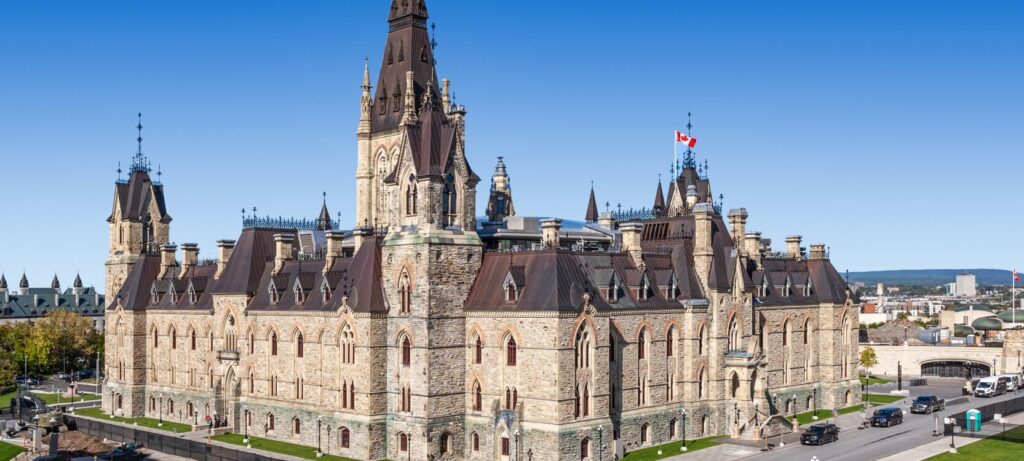
Renovation and modernization projects
A major project to restore and modernize the Parliament Buildings, begun in 2002, will ensure that the complex not only preserves its historic heritage but also adapts to the changing demands of modernity. The project includes:
- Complete reconstruction of the Central Block, including strengthening of the foundations and load-bearing structures
- Modernization of engineering communications, electrical wiring and security systems
- Creation of new underground spaces to serve visitors and parliamentarians
- Construction of a new Visitors’ Center, which will improve accessibility and security at the complex
This work represents the largest restoration of the buildings since their original construction and reconstruction following the 1916 fire. Upon completion of the project, Parliament Hill is expected to be ready to serve Canadian democracy for at least another 100 years.
Challenges and opportunities for parliamentarism in the digital age
As information technology advances, it is not only the physical space of Parliament Hill that is changing, but also the very nature of parliamentary work. Digitalization makes the legislative process more transparent and accessible to citizens, which is in line with the country’s democratic principles.
At the same time, parliamentarians face new challenges: information wars, cyber threats and the spread of misinformation require new approaches to ensuring the integrity of the democratic process. The Canadian Parliament is actively adopting digital tools and platforms to increase citizen engagement in the legislative process while preserving traditional principles of parliamentarianism.
Parliament Hill as an educational platform
Educational programs and initiatives
Parliament Hill serves as an important educational platform to introduce Canadians of all ages to the principles of democracy and citizenship. The Parliament of Canada organizes many educational programs:
- Study Tours for school groups
- Parliamentary Pages Program, which allows students to work in the House of Commons or Senate
- Parliamentary Guide Program, where students give tours to visitors
- Interactive Education Center, where visitors can learn about the legislative process
The Library of Parliament also plays an important educational role, providing information resources and analysis not only for parliamentarians, but also for researchers and the public. Its educational programs and resources help Canadians better understand their political system and history.
Virtual presence and digital initiatives
In addition to physical visits, the Parliament of Canada is developing a virtual presence through:
- Virtual tours of Parliament buildings, accessible through the official website
- Educational online resources about Parliament’s work for teachers and students
- Live streaming of parliamentary debates and committee meetings
- Social media channels to engage with citizens
These initiatives make parliamentary activities more accessible to Canadians living in remote areas of the vast country and promote greater citizen participation in the democratic process.
Final Reflections
Parliament Hill in Ottawa is not just a complex of historic buildings or the seat of the country’s highest legislative body. It is the living embodiment of Canadian democracy, a witness to the nation’s evolution from colonial status to a sovereign state, and a symbol of Canada’s aspirations for a just, inclusive and prosperous society.
The neo-Gothic spires and domes overlooking the Ottawa River recall the deep British roots of Canadian parliamentarianism, but the multilingualism, cultural diversity and inclusiveness that characterize Parliament’s modern work reflect the unique path Canada has taken in its development as an independent nation.
In an era of global challenges – from climate change to the digital transformation of society – Parliament Hill remains not only the physical center of government decision-making, but also a symbol of the traditions, values and aspirations of the Canadian people. Its stately buildings and open spaces serve as a reminder that democracy is not a static state, but a constantly evolving process that requires the participation of every citizen.
Today, as it was more than 150 years ago, Parliament Hill continues to be the center around which Canada’s national history and identity are shaped, bringing together the nation’s past, present and future in one symbolically significant space.
The importance of Parliament Hill in shaping Canada’s foreign policy
A center of diplomatic activity
Parliament Hill plays an important role in shaping and implementing Canada’s foreign policy. It is here that meetings with foreign delegations, speeches by foreign leaders before Parliament and important international negotiations take place. Over the years, Parliament Hill has hosted many foreign dignitaries, including monarchs, presidents, prime ministers and UN secretaries general.
One of the most significant moments was when U.S. President John F. Kennedy addressed the Canadian Parliament in 1961, when he uttered his famous line that “geography has made us neighbors, history has made us friends, economics has made us partners, and necessity has made us allies.”
The flags of other nations are flown on Parliament Hill during official visits by heads of state, and on special occasions the Parliament buildings are illuminated with the colors of other nations’ flags as a sign of solidarity or grief. For example, after the terrorist attacks of September 11, 2001, approximately 100,000 Canadians gathered on the main lawn of Parliament Hill to honor the victims and show support for the American people.
Role in international relations
Parliament Buildings has International Affairs and Foreign Policy Committees, which review international treaties and agreements before ratification. Members and senators discuss the country’s foreign policy and participation in international organizations such as the United Nations, NATO, G7, and the Commonwealth of Nations.
Parliament Hill is also a center for parliamentary diplomacy through inter-parliamentary associations and friendship groups with legislatures in other countries. These mechanisms allow Canadian parliamentarians to maintain a dialog with their counterparts in other countries and promote Canadian values in the international arena.
Parliamentary Hill and electoral reform
Debates about democratic representation
For decades, there have been discussions on Parliament Hill about possible reform of Canada’s electoral system. The current first-past-the-post (first-past-the-post) relative majority system has been repeatedly criticized for its potential to produce a government with less than 40% of the popular vote.
In 2015, the Liberal Party, led by Justin Trudeau, came to power with the promise that this would be the last election under the relative majority system. While this reform never materialized, the debate about the need to move to a more proportional system of representation continues within the walls of Parliament.
Electoral geography and regional representation
A feature of the Canadian parliamentary system is the uneven distribution of electoral districts among the provinces and territories. This reflects the difficulty of ensuring fair representation in a country with a vast territory and uneven population density.
Issues of regional representation in Parliament are regularly debated in chambers and committees on Parliament Hill. One of the tasks of the Senate as the upper house is to ensure regional balance, as senators are appointed according to regional quotas, regardless of population size.
Social role of Parliament Hill
A place for public dialog and demonstrations
Parliament Hill has historically served as the primary venue for the expression of public opinion in Canada. As a symbol of democratic freedoms, the Hill is regularly the site of demonstrations, marches and protests on issues ranging from Indigenous rights and environmental issues to economic policy and international relations.
Every year, thousands of Canadians come to the hill to express their views on current issues. Canadian authorities generally respect the right of citizens to peacefully assemble and protest near parliamentary buildings, reflecting the country’s commitment to the values of free speech and democracy.
One example of mass civic engagement on Parliament Hill was the “Freedom Convoy” trucker protests in 2022, when thousands of trucks paralyzed downtown Ottawa. This event sparked a serious debate about the balance between the right to protest and the normal functioning of government institutions.
A platform for national dialog
Parliament Hill serves as a national platform for dialog on major public issues. It hosts parliamentary hearings and committee meetings where experts, civil society representatives and ordinary citizens can express their opinions on draft laws and government initiatives.
Through broadcast parliamentary debates and open committee meetings, Canadians can follow the debate on issues that matter to them and evaluate the performance of their elected representatives. This transparency is an important feature of Canada’s democratic system and holds politicians accountable to their constituents.
Daily life on Parliament Hill
The daily routine of parliamentarians and staff
Behind the majestic facades of the parliamentary buildings, there is a lot of hard work going on every day. On weekdays, Parliament Hill is a hive of activity as senators and MPs participate in plenary sessions and committees, meet with constituents and colleagues, draft legislation and hold press conferences.
A large staff is employed to keep parliament functioning, from administrative staff, researchers and lawyers to translators, technicians and maintenance staff. In total, more than 3,000 people work in parliamentary buildings every day.
The parliamentary buildings also house restaurants and cafeterias for staff and visitors, a post office, ATMs and even a barber shop. A lively place is the Parliamentary Press Club, located just outside the parliament building on Wellington Street, where journalists, columnists from national television corporations and foreign media correspondents come to exchange information and engage in policy discussions.
Life behind the scenes: little-known facts about Parliament Hill
Behind the official facade of parliamentary life, there are many interesting details and traditions. For example, the parliament building has a “cat sanctuary” – a special place where a colony of parliamentary cats lives, which historically served the function of rodent control.
On the grounds of Parliament Hill is the Survivors Maple, a tree grown from the seeds of a maple tree that survived the atomic bombing of Hiroshima. The tree was planted as a symbol of peace and sustainability in Canada’s international relations with Japan.
A little-known feature of the Parliament Buildings is the network of tunnels connecting different parts of the complex and nearby government buildings. These tunnels allow parliamentarians and staff to move between buildings without going outside, which is especially important in the harsh Canadian winters, when temperatures can drop to -30°C.
Unique features and traditions of Canadian parliamentarianism
The Library of Parliament and its role
The Library of Parliament, the architectural jewel of the complex, serves not only as a repository of books, but also as an important research and information center. The Library provides independent, impartial research and analysis for parliamentarians and parliamentary committees on a wide range of issues.
Unlike many other parliamentary libraries around the world, the Library of the Parliament of Canada provides information support for both the governing party and the opposition, which contributes to more informed debate and legislative decisions. The Library also administers educational programs and publishes materials to inform the public about the parliamentary system.
Unique ceremonial traditions
The Canadian Parliament retains a number of unique ceremonial traditions, many of which have roots in British parliamentarianism but have taken on a Canadian character:
- Door Knocking Ceremony – when the Black Rod (an officer of the Senate) knocks on the door of the House of Commons to summon MPs to the Senate to hear the Throne Speech or Royal Assent.
- Search for the Speaker – a tradition in which the newly elected Speaker of the House of Commons “resists” his appointment and is symbolically “forced” into the Speaker’s chair.
- Prayer Book Reading – at the beginning of each sitting of the House of Commons, the Speaker reads a prayer asking for divine guidance in the work of parliamentarians.
Parliament Hill in the age of digital democracy
Adapting to new technologies
In the age of digitalization, Parliament Hill is adapting to new technological realities. Recent years have seen the introduction of e-voting, digital document archiving, and improved technology for hybrid meetings.
Social media has changed the nature of political communication, with many parliamentarians actively using Twitter, Facebook and other platforms to communicate directly with constituents. Parliamentary and committee meetings are broadcast live over the Internet, making the legislative process more accessible to citizens.
Challenges of the digital age
Parliament Hill faces new challenges of the digital age: cybersecurity is becoming a critical issue to protect parliamentary systems and data from hacker attacks and interference. The issues of misinformation, fake news and manipulation of public opinion through social media create a new battleground to protect the integrity of the democratic process.
Parliamentary committees hold regular hearings on regulating tech giants, protecting citizens’ personal data, and ensuring Canada’s digital sovereignty. These discussions form the basis for legislation that must strike a balance between technological innovation and the protection of democratic values.
Parliament Hill through the lens of federalism and regional interests
Provincial and territorial representation
Canadian federalism involves a complex balance between the federal government and provincial/territorial governments. Parliament Hill is the place where this balance is constantly debated, challenged and renegotiated.
The interests of Canada’s various regions are represented both through elected MPs from each constituency and through senators appointed by regional quotas. This dual representation is designed to ensure that both popular (through the House of Commons) and regional interests (through the Senate) are taken into account.
Federal-Provincial Relations
Parliament Hill has witnessed many critical moments in the development of Canadian federalism, including constitutional crises, provincial demands for greater autonomy, and debates about national unity. Key documents drafted and debated here include:
- The Constitution Act of 1982, which included the Charter of Rights and Freedoms
- The Meacham Agreement of 1987 (not adopted)
- The Charlottetown Agreement of 1992 (rejected in a referendum)
- The Clarity Act of 2000, setting the conditions for the province’s potential withdrawal from Confederation
These debates reflected the complex dynamics of Canadian federalism and the desire to find a balance between the unity of the nation and the recognition of its diversity.
Climate and environmental aspects of Parliament Hill
Sustainability and greening
The renovation of the Parliament Buildings emphasizes improving the environmental sustainability of the complex. Modernization includes:
- Installation of energy efficient HVAC systems
- Utilization of geothermal energy for part of the buildings’ energy needs
- Implementation of rainwater harvesting systems for irrigation of gardens and fountains
- Improving the thermal insulation of historic buildings without compromising their architectural value
The hill is planted predominantly with native plant species that require minimal irrigation and the green spaces are managed in a biodiversity-friendly manner.
Adaptation to climate change
Parliament Hill has not only become a platform for discussing climate change policy, but is itself adapting to the effects of climate change. In recent years, Ottawa has faced more extreme weather conditions, including flooding and severe summer storms.
As part of the modernization of the complex, measures are being developed to strengthen infrastructure and make buildings more resilient to extreme weather events. Risks associated with rising Ottawa River levels during spring floods are also being considered, requiring additional engineering solutions to protect the complex.
Epilogue: Parliament Hill as a symbol and the future of Canadian democracy
Symbolic significance for future generations
Parliament Hill remains not only the physical but also the emotional center of Canadian citizenship and identity. Its significance goes far beyond the functional role of the place where Parliament sits. It is a symbol of the democratic values for which sacrifices were made on the battlefields and of the democratic processes that are constantly evolving to meet the new challenges of the times.
For future generations of Canadians, Parliament Hill will serve as a reminder of the need for continued engagement in the democratic process, the importance of compromise and dialog in resolving differences, and that democracy is not a given, but a process that requires constant attention and care.
Visions of the Future: Parliament Hill in the Twenty-Second Century
Looking to the future, one can envision Parliament Hill as a symbol of an adaptive democracy that can evolve with the society it serves. As Canada becomes more diverse and globally interconnected, parliamentary institutions will continue to adapt to reflect the changing nature of Canadian society.
Technological innovations may change the way citizens interact with Parliament, but the core principles of representative democracy embodied in the stately buildings of Parliament Hill are likely to remain relevant. As they have in the past, these buildings will stand as witnesses to historical events, political debates and national celebrations, connecting the past, present and future of the Canadian nation.
Conclusion
Parliament Hill in Ottawa is much more than a complex of government buildings or a tourist attraction. It is the living embodiment of Canadian democracy, the place where the nation’s history is played out every day, where its present is shaped and the foundations of its future are laid.
From the early days of Confederation to the modern era of globalization and digital technology, Parliament Hill continues to serve as the core of Canada’s nationhood. Its neo-Gothic towers, seamlessly blended into the Canadian landscape, symbolize the country’s unique journey of combining its British constitutional heritage with its own experience of building a multicultural federal state.
In a world where democratic institutions face new challenges – from the polarization of society to information threats – Parliament Hill remains a reminder of the value of democratic dialogue, the power of compromise and the importance of respect for different points of view. As former Canadian Prime Minister Pierre Trudeau said, “Democracy is not just the presence of institutions, it is a state of mind.”
Standing on the banks of the Ottawa River, the majestic Parliament Buildings continue to preserve the spirit of Canadian democracy, reminding every visitor that it is ultimately the people who are the source of power and the guarantor of democratic freedoms. And as long as Canadian citizens remain committed to these ideals, Parliament Hill will stand as the true heart of Canadian democracy – a place where the past meets the present and together they shape the future of the nation.
Author Information

I’m a journalist specializing in urban issues and city politics in the Vancouver region, which I’ve covered since 1994, and I also have a strong focus on the iGaming industry. In this endlessly changing city, I cover a broad range of issues: from drug policy, bike lanes, billion-dollar development projects, homelessness, and garbage debates, to the rapidly evolving world of online gaming, including regulatory landscapes, technological advancements, and market trends. I write frequently for the Globe and Mail’s B.C. section and Report on Business. From 2008 to 2015, I had a regular column in Vancouver magazine, “Urban Fix,” which apparently resonated with readers so much that it earned me a few regional and national awards.
