
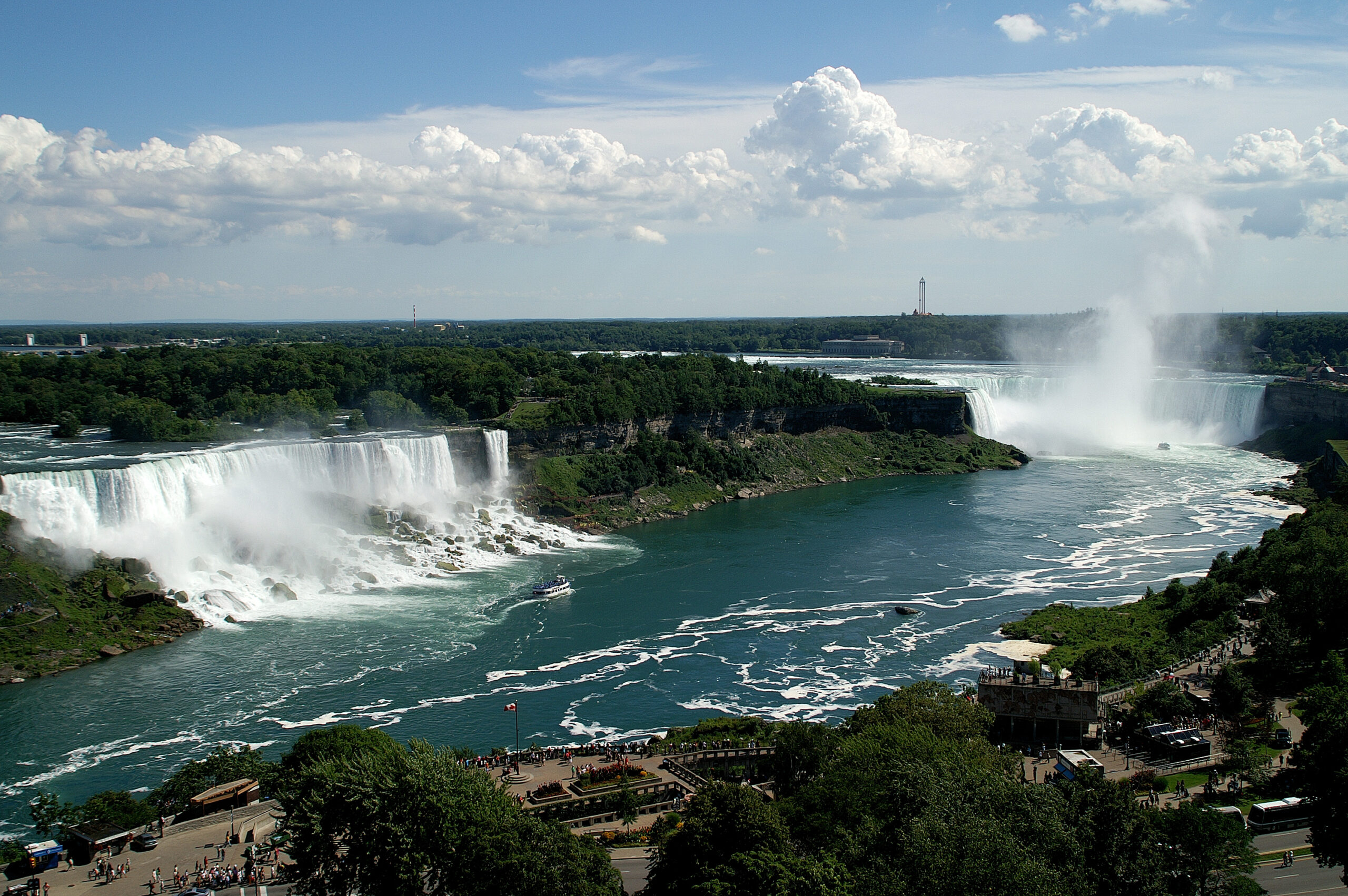
A majestic force of nature falling from a height of 53 meters and creating a cloud of spray visible tens of kilometers away – Niagara Falls is rightly considered one of the most impressive wonders of the world. A frontier attraction shared between Canada and the United States, it attracts some 30 million tourists each year. But behind the facade of postcard views and popular hiking trails lie surprising secrets and little-known facts that few people have heard of.
Natural splendor: the anatomy of a waterfall
Before diving into the mysteries of Niagara, it is important to understand its structure. Niagara Falls is not a single stream, but a complex of three separate waterfalls:
- American Falls (American Falls) – located entirely within the United States
- Bridal Veil Falls – also on the U.S. side, separated from American Falls by Luna Island
- Horseshoe Falls – the largest of the three, located mostly in Canadian territory
Every second about 2,800 cubic meters of water falls from these three falls, making Niagara one of the most powerful waterfalls in North America. However, it should be noted that the height of Niagara Falls is significantly inferior to many others – even on the American continent there are more than 50 waterfalls that surpass it in this parameter.
Secret history: from a sacred place to a tourist Mecca
Indigenous people and legends of Thunder Waters
Long before European settlers arrived, Niagara was a sacred place for indigenous peoples – primarily the Iroquois. They called the falls “Thunder Waters” (Onguiaahra, later transformed into “Niagara”). According to ancient beliefs, the cave behind the falls was home to the powerful spirit of He-no, the God of Thunder.
One of the most famous legends is related to a girl named Lelawala, the daughter of a chief. According to the legend, she was sent on a sacrificial canoe across the falls to propitiate He-no and stop the spread of disease in the tribe. The Thunder God saved the girl by taking her to his dwelling behind the falls, where she became an intermediary between humans and spirits.
“Niagara Falls is not merely a natural attraction – it is a place of spiritual power, where heaven meets earth in a rumbling embrace of water and air” – from the notes of explorer and ethnographer Henry Sculcraft, 1846.
The first Europeans: from discovery to exploitation
The first European to see and describe Niagara Falls was the French explorer Louis Ennepin in 1678. In his notes, he noted, “The waters fall with such fury into this awful abyss as to produce an amazement that cannot be expressed in words.” His somewhat exaggerated descriptions of a waterfall “more than 600 feet high” (actually about 170 feet) nevertheless fired the imagination of Europeans.
By the mid-nineteenth century, Niagara had already become a popular tourist destination, especially after the completion of the railroad connecting New York City and the falls. This was a period of rapid and often uncontrolled tourism development, when numerous observation decks, souvenir shops and attractions of dubious quality began to appear along both sides of the river.
Hidden secrets and little known facts
Niagara … stops?
One of the most surprising and little-known facts: Niagara Falls has completely stopped! on March 30, 1848, an event occurred that locals mistook for the end of the world – the falls suddenly went silent. Strong winds and an ice jam on Lake Erie created a natural dam, cutting off the flow of water for 30-40 hours.
Locals wandered the exposed river bottom in panic, collecting artifacts, weapons, and even the remains of dead people who had been hiding under the churning waters for decades. Muskets of British soldiers from the War of 1812 and many Native American relics were found.
In more modern times, in 1969, the American side of the falls was deliberately “turned off” by the U.S. Army Corps of Engineers for several months. The purpose of this unprecedented project was to study rock erosion and perform rock stabilization work. Residents and tourists could see a surreal picture of dry rocks where a powerful stream would normally have come down.
The secret room behind the waterfall
Behind the colossal water curtain of the Horseshoe Falls lies an amazing space that few people know about – the so-called “Cave of the Winds”. Until the 1920s, tourists could tour this mysterious place where the thundering roar of the water and gusts of wind created an almost mystical experience.
After a serious rockfall in 1920, access to the cave was closed to the public for safety reasons. Today, only geologists and explorers have the rare opportunity to visit this mysterious place where you can literally stand behind a wall of water and feel the primal power of nature.
A ship on the brink: the amazing story of the “Old Rusty Guard”
In 1918, a steel barge broke loose from its tugboat and raced inexorably towards the falls. On board were Gustav Lanberg and James Harris, who were certain of imminent doom. Miraculously, the barge was stuck only 600 meters from the edge of the precipice in shallow water.
The rescue operation turned into a real technical challenge for the time. Both men were eventually rescued using a specially designed rope system and a rescue basket thrown from a bridge over the river. Amazingly, the hulk of this barge, called the Old Rusty Guard, remained visible until 2021 – for over a hundred years it served as a reminder of the incredible rescue.
A secret hydroelectric plant and underground complex
Few people know that beneath the observation decks and hiking trails lurks a massive industrial complex. Niagara Falls is not only a beautiful natural site, but also one of the largest sources of hydroelectric power in the world.
Tunnels reaching a length of 10 kilometers are drilled in the rocks on both sides of the boundary. They divert part of the water from upstream to generate electricity. The underground machine rooms resemble the sets of James Bond movies – giant generators run in vast caverns cut into the rock.
Interesting fact: at night and during the low tourist season, much of the water is diverted to generate electricity, reducing the volume of water flowing through the falls by more than half. Many tourists do not even realize that they are witnessing a “lighter version” of a natural wonder.
The Dark Side of Niagara: the Falls of Death and Despair
A place of sad records
Behind the ravishing beauty of Niagara Falls lies a grim statistic. It is one of the most popular suicide spots in the world – according to various estimates, more than 5,000 people have ended their lives here since 1850. The Rainbow Bridge on the American side is particularly notorious.
To counter this tragic trend, surveillance cameras, emergency phones and increased patrols have been installed. In addition, research is being conducted on “places of attraction” for suicides to better understand the psychological mechanisms of this phenomenon and to develop more effective prevention methods.
Daredevils and madmen: the conquerors of the Falls
The history of Niagara is inextricably linked to stuntmen and thrill seekers who attempted to conquer the falls in various devices. Annie Edson Taylor was the first to successfully climb the falls in 1901 – the 63-year-old schoolteacher survived a fall in a specially designed barrel, although she was seriously injured.
Since then, about 15 people have made similar attempts in barrels, balls and other homemade devices. About a third of these daredevils have died. Since 1951, such stunts have been officially banned, and violators face serious fines and even jail time.
One of the most amazing cases of survival was the story of Roger Woodward. In 1960, a seven-year-old boy accidentally fell into a waterfall without any protection, just wearing a life jacket, after the boat he was in with his family capsized upstream. Against all odds, he survived with only minor injuries.
Geologic mysteries: the past and future of the falls
A moving natural wonder
Few people know that Niagara Falls is a geologically young and ever-changing formation. About 12,000 years ago, when the last glacier retreated, the Falls were located in the area of present-day Niagara-on-the-Lake, 11 kilometers from its current position. Over the millennia, erosion gradually “moved” the falls upstream.
Before human intervention, the rate of erosion was about 1-3 meters per year. Today, thanks to engineering works and redistribution of water flow, this process has slowed down considerably – up to 30 centimeters per year.
Geologists predict that at the current rate of erosion in about 50,000 years the waterfall may disappear completely, “retreating” to Lake Erie. However, modern erosion control techniques will probably allow this timeframe to be significantly longer.
Underwater caves and sunken treasures
Beneath the raging waters of the Niagara River lies a world of caves, crevices and geologic formations that are nearly impossible to explore due to the extreme conditions. Scuba divers cannot dive into these waters due to the strongest currents and whirlpools.
Estimates by collectors and historians suggest that there could be millions of dollars worth of valuables at the bottom of Niagara, from coins tossed by tourists for good luck to jewelry and artifacts from the many shipwrecks that have occurred upstream over the past two centuries.
Niagara Beyond the Tourist Trails
Ghost Town Beyond the Falls
In the shadow of Niagara Falls’ tourist splendor lies a history of economic decline. The city of Niagara Falls on the U.S. side is often cited as an example of the “curse of tourism,” a phenomenon in which over-reliance on one industry leads to systemic problems.
Once a thriving industrial center with chemical plants and hydroelectric power plants, U.S. Niagara Falls has lost about half of its population since the 1960s. Behind the glitzy tourist facade, just a few blocks from the falls, begin neighborhoods with abandoned buildings and signs of economic depression.
The Canadian side is booming thanks to a more diversified economy that includes not only tourism but also the entertainment industry (casinos, shows, restaurants).
Environmental issues: from pollution to revitalization
The history of Niagara Falls is also the story of the struggle for ecological balance. In the 1960s and 70s, the Niagara River was one of the most polluted bodies of water in North America due to the many chemical plants located upstream.
An infamous pollution incident in the Love Canal area near the falls in 1978 led to the evacuation of hundreds of families and was a turning point in U.S. environmental law. Since then, significant efforts have been made to clean up the river and surrounding areas.
Today, the environmental situation is much improved due to strict pollution controls and international cooperation between the U.S. and Canada. The return of some bird and fish species attests to the success of these measures, although problems still remain.
Current mysteries and research
Niagara in the dark: the secret night life of the falls
Since 1925, the falls have been illuminated by floodlights, creating an impressive nighttime spectacle. But few people know that every night at certain hours the illumination is turned off. This is not only to save energy, but also for environmental reasons – the constant illumination disrupts the natural cycles of the local fauna.
Researchers use these “dark hours” to study the waterfall using special infrared equipment, which allows them to obtain unique data on the structure of water flows and microclimate.
Niagara’s Acoustic Phenomena
The soundscape of Niagara Falls is unique. The low-frequency vibrations created by the falling water travel many kilometers and are detected by seismic sensors. These sound vibrations are on the edge of the audible range and are perceived by humans more as a physical sensation than as sound.
Researchers at the University of Buffalo have found that these low-frequency vibrations can affect people’s emotional state, inducing feelings of awe and delight even in those who cannot visually observe the falls. Some scientists suggest that it is these acoustic features that partially explain Niagara’s “magnetism” and its special place in culture.
Cultural Phenomenon: Niagara in Art and Popular Culture
Niagara Falls has inspired artists, writers, and filmmakers for centuries. From 19th century romantic paintings to the classic 1953 movie Niagara with Marilyn Monroe, this natural phenomenon is firmly embedded in the cultural code of North America.
Interestingly, perceptions of Niagara have changed over time. During the colonial period, the waterfall symbolized the indomitable power of the New World wilderness. In the 19th century, it became a symbol of the sublime and romantic in art. By the mid-20th century, Niagara became associated with commercial tourism and honeymoons, and today it is increasingly viewed through the lens of environmental concerns and sustainable development.
Practical tips for the explorer of Niagara’s mysteries
For those who wish to discover the little-known sides of Niagara Falls, there are a few recommendations:
Visit in the off-season – there are far fewer tourists between November and April, allowing for a more relaxed exploration of the area.
Explore both sides – the American and Canadian sides offer very different experiences. The Canadian side is known for panoramic views, while the American side allows you to get closer to the water.
Take a gorge hike – the trails along the Niagara Gorge below the falls allow you to see unique geologic formations and learn more about the evolution of the falls.
Visit the Tesla Museum – a small but informative museum dedicated to Nikola Tesla’s connection to Niagara Falls and the first major hydroelectric power plant.
Explore Goat Island, a small island between the American Falls where you can feel the power of the water literally beneath your feet through special viewing platforms.
The timeless allure of falling water
Niagara Falls remains one of the most breathtaking natural wonders on the planet, combining outward beauty and hidden secrets. Behind the tourist facade and postcard views lies a complex ecosystem, a rich history and an ever-changing geological phenomenon.
Perhaps the true charm of Niagara lies in this combination of the obvious and the hidden – what can be seen at a glance and the secrets that are only revealed to the inquisitive explorer. The Falls continue to attract millions of visitors from all over the world, and everyone finds something different in it – from awe of the forces of nature to scientific interest in a unique geological phenomenon.
Niagara Falls is not just a tourist attraction, but a living symbol of the indomitable power of nature, reminding us that even in the age of high technology and virtual reality, this pristine power continues to inspire and delight us
Author Information

I’m a journalist specializing in urban issues and city politics in the Vancouver region, which I’ve covered since 1994, and I also have a strong focus on the iGaming industry. In this endlessly changing city, I cover a broad range of issues: from drug policy, bike lanes, billion-dollar development projects, homelessness, and garbage debates, to the rapidly evolving world of online gaming, including regulatory landscapes, technological advancements, and market trends. I write frequently for the Globe and Mail’s B.C. section and Report on Business. From 2008 to 2015, I had a regular column in Vancouver magazine, “Urban Fix,” which apparently resonated with readers so much that it earned me a few regional and national awards.
