
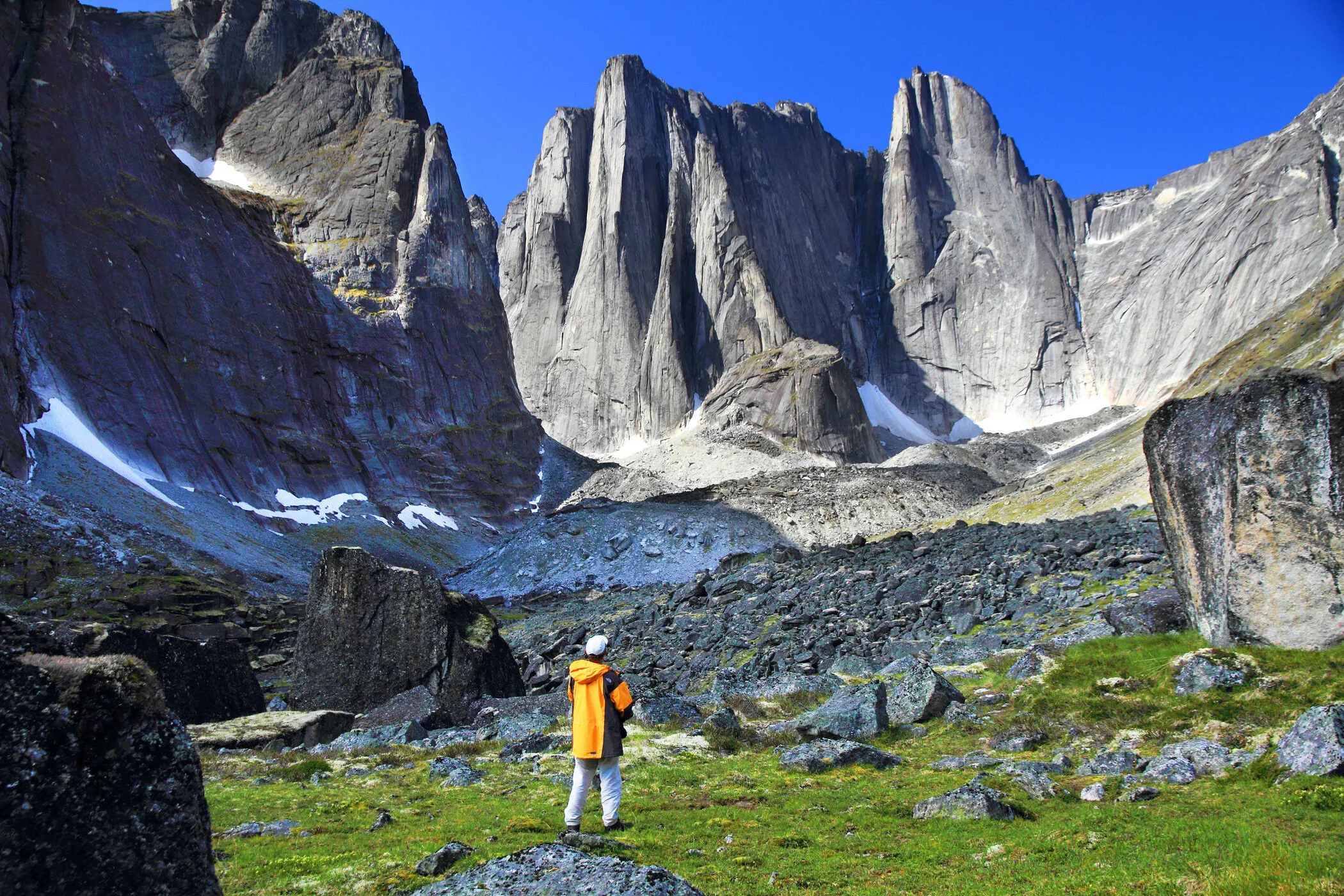
Nestled in Canada’s wild and undiscovered Northwest Territories is one of the country’s most enigmatic and spectacular wilderness areas, Nahanni National Park. A UNESCO World Heritage Site since 1978, this amazing wilderness is a paradise for nature lovers, adventurers and those who want to see some of North America’s most stunning natural beauty.

History and Location
Nahanni National Park was established in 1976 and covers an area of 4,766 square kilometers (as of its founding). In 2009, the Canadian government, in conjunction with the Dehcho First Nation, announced plans to expand the park more than sixfold to 30,000 square kilometers, which would include 91% of the Greater Nahanni Ecosystem.
The park is located in the South Nahanni River Valley (a tributary of the Liard River), 500 kilometers west of the Northwest Territories’ capital city of Yellowknife, at the southern end of the Mackenzie Mountains. The name “Nahanni” means “soul” in the Dene (the indigenous people of this area) language, reflecting the deep spiritual connection of the local people to these lands.
Interestingly, the park is fairly isolated – the nearest population centers are Fort Simpson, Fort Liard and Nahanni-Byatt, but even these are not easily accessible. There are no roads or other elements of tourist infrastructure in the park, making it one of the wildest and most unspoiled reserves in North America.
Natural Attractions
The South Nahanni River and its canyons
The centerpiece of the national park is the South Nahanni River, one of the most scenic and wild rivers in North America. Along its path it forms four spectacular canyons, known simply as the First, Second, Third, and Fourth Canyons. The canyon walls reach heights of 1,200 meters, creating truly breathtaking scenery.
the 200-kilometer journey up the Nahanni River from Nahanni Butte to Virginia Falls is an unforgettable experience for intrepid travelers. Along the way, the river flows between the high walls of the First Canyon, passes through the so-called Valley of the Dead, cuts into the Second Canyon, and then makes a 90-degree turn through the “Gateway” in the Third Canyon, guarded by the mighty Chair Rock. Beyond the canyons are foaming rapids with the telling name of “Hell’s Gate,” and after the Fourth Canyon the river makes a bend, revealing a sudden and breathtaking view of the famous Virginia Falls.

Virginia Falls is the crown jewel of the park
Without a doubt, the main attraction of the park is the majestic Virginia Falls. This impressive natural phenomenon falls from a height of 90 meters, which is twice as high as the famous Niagara Falls. With a total width of about 259 meters, Virginia Falls is one of the most powerful and impressive waterfalls in North America.
At the very center of the falls stands Mason Rock, named after Bill Mason, a famous Canadian screenwriter and director. This rock divides the stream into two parts: the southern part, lower down to the river, and the northern part, where the water falls steeply downward. The spectacle of water falling from a great height, surrounded by untouched nature, leaves a lasting impression on all who are lucky enough to see it.
The waterfall has several names: the official name is Virginia Falls, as well as Na’ili Cho and Mahoney Falls. In the Dene language, Na’ili Cho translates to “big falling water.” The name Mahoney Falls comes from a hunter who explored these areas in 1928 and was one of the first settlers of the Yukon.
Hot springs and other geologic wonders
Nahanni Park is not only famous for its waterfalls and canyons, but also for its unique geologic features. One of these features is the sulfur hot springs, whose water temperature reaches about 37 degrees Celsius. Thanks to these springs, an ecosystem with unusual vegetation has formed here, unique for northern latitudes.
Rabbit Kettle Hot Springs (Rabbit Kettle Hot Springs or Ganikhta in the indigenous language) have become particularly famous. These springs and the surrounding mounds of tuff (calcium carbonate deposits) are the largest such formations in Canada. Local legends say that these springs were used to cook food by giants who supposedly lived in the Nahanni Valley.
The karst ridges of the South Mackenzie Mountains abound with caves and gorges hollowed out by water as softer minerals dissolved into limestone. These unique formations attract speleologists and explorers from around the world.

Flora and fauna
The area of the park represents a variety of ecosystems including boreal forests, alpine tundra, and the unique microclimates around the hot springs. This diversity of habitats contributes to the richness of the flora and fauna.
Nahanni is a natural habitat for 42 species of mammals and 180 species of birds. It is home to black and grizzly bears (estimated at about 500 individuals), wolves and lynx, moose and caribou (reindeer), snow sheep and goats, foxes and beavers, otters and marmots. Birds include hawks, golden eagles, peregrine falcons and gyrfalcons.
The expansion of the park in 2009 included the habitat of two herds of woodland caribou, as well as the highest mountains and largest glaciers in the Northwest Territories.
The park’s plant life is also impressively diverse. There are mixed forests of spruce and poplar trees in the river valley and tundra vegetation in the alpine zone. Of particular interest are the plants found around the hot springs – here, in the ground, which never freezes, plants such as ferns, roses and wild cherries grow exceptional for such northern latitudes.
Mysticism and legends of the Nahanni Valley
In addition to its natural beauty, the Nahanni Valley is known as the “Valley of the Headless Men” due to a number of mysterious incidents that took place in the early 20th century. These stories add a special air of mystery and mystique to the place.
The history of the valley is shrouded in legends about the Naha tribe, which, according to the Dene natives, lived high in the mountains and only came down to the valley for raids. According to legend, this tribe suddenly disappeared, leaving behind only abandoned huts.
At the end of the XIX century, during the gold rush, fortune seekers rushed to the valley. It was then that mysterious disappearances began. The most famous case was the story of the McLeod brothers, who went in search of gold and did not return. Two years later, their skeletons were found without heads. A string of similar cases followed, which only added to the valley’s grim fame.
Locals tell of evil spirits that roam the valley and sometimes make strange cries on cold, windy nights. Some believe that Nahanni is home to giants who use the hot springs of the Rabbit Cauldron for cooking. Others tell of the wahil, a large wolf-like creature that is associated with strange occurrences in the valley.
Despite all these stories, modern researchers tend to attribute most of the disappearances to harsh natural conditions, the presence of dangerous predators and the difficulty of surviving in such an isolated area.
Tourism and outdoor activities
Nahanni National Park is open all year round, but most tourists visit during the summer months. Due to the remoteness and lack of roads, access to the park is limited – the main ways to get here are by seaplane or helicopter.
The most popular activities in the park include:
- Canoeing and rafting on the South Nahanni River is the primary activity for most visitors. Trips typically range from one to three weeks and require a high degree of paddling skills, so most tourists book trips through licensed commercial organizers.
- Hiking – there are no paved, well-marked or maintained trails in the park, only trails through the bush that have evolved over the years into trail-like paths. Hiking is usually combined with river rafting.
- Rock Climbing – Nahanni has long been a popular destination for rock climbers. The main area for this sport is the Ragged Ridge of the Mackenzie Mountains. The Circus of the Impassable has become particularly famous, and the Lotus Flower Tower is considered one of the most coveted routes for professional rock climbers.
- Fishing – the park’s rivers and lakes are home to species such as Arctic grayling, bull trout, Dolly Varden, pikeperch, walleye, lake trout, pike and whitefish. Due to low fishing pressure, the fish here reach impressive sizes.
- Sightseeingtours – for those who can’t or don’t want to tackle the difficult trails, sightseeing tours by seaplane or helicopter are available. Typical tours include a flyover of Virginia Falls (2-3 hours), as well as longer tours covering Glacier Lake and other notable areas of the park.

How to get there and practical information
Getting to Nahanni National Park is not easy. The nearest population center is the town of Fort Simpson, from where you can fly to the park by seaplane. Several companies offer charter air transportation:
- Simpson Air: Fort Simpson, Northwest Territories
- South Nahanni Airways: Fort Simpson, Northwest Territories
Visitors must obtain a permit from the park administration to visit the park. This is due to both visitor safety and the preservation of the untouched nature of the reserve.
It is important to remember that the park is in a remote area with harsh conditions, so it is necessary to plan your trip carefully, take into account weather conditions and have the appropriate equipment and experience, especially if you are planning a self-guided rafting or hiking trip.
Author Information

I’m a journalist specializing in urban issues and city politics in the Vancouver region, which I’ve covered since 1994, and I also have a strong focus on the iGaming industry. In this endlessly changing city, I cover a broad range of issues: from drug policy, bike lanes, billion-dollar development projects, homelessness, and garbage debates, to the rapidly evolving world of online gaming, including regulatory landscapes, technological advancements, and market trends. I write frequently for the Globe and Mail’s B.C. section and Report on Business. From 2008 to 2015, I had a regular column in Vancouver magazine, “Urban Fix,” which apparently resonated with readers so much that it earned me a few regional and national awards.
