
Introduction
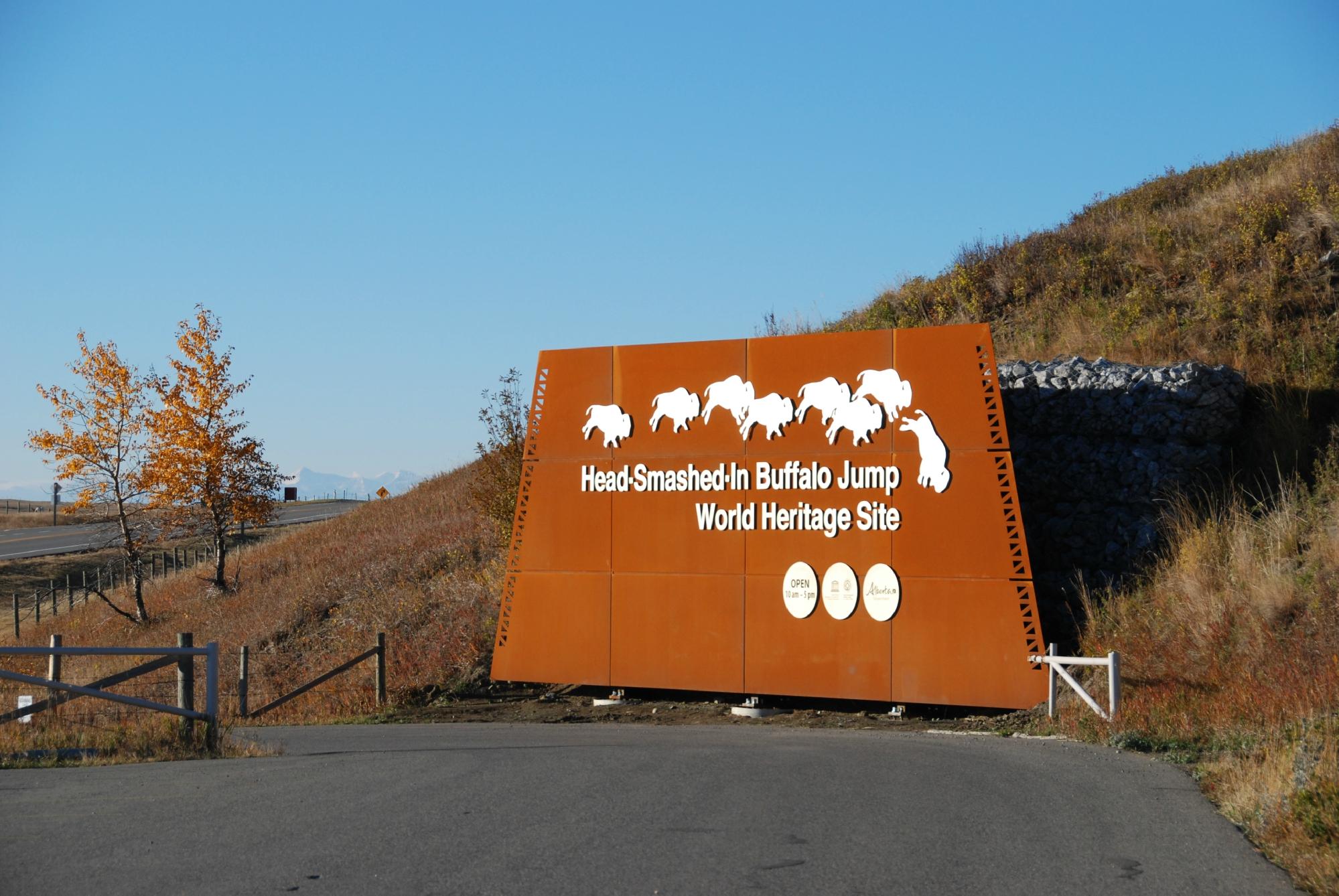
Head-Smashed-In Buffalo Jump is an amazing historic site located in the foothills of the Rocky Mountains in the province of Alberta, Canada, approximately 18 kilometers northwest of the town of Fort Macleod. This unique archaeological complex testifies to an ancient method of bison hunting practiced by the indigenous peoples of the North American plains for nearly 6,000 years. In 1981, UNESCO recognized Head Smashed-In Buffalo Jump as a World Heritage Site, emphasizing its exceptional cultural and historical value.
Origin of the name
The name of the place has an interesting history. In the language of the Blackfoot (Blackfeet) tribe, it sounds like “Estipah-skikikini-kots”. According to legend, a young Blackfoot warrior wanted to watch the bison fall from the cliff below, but found himself buried under the falling animals. When he was found dead under a pile of carcasses, his head had been crushed – hence the name “Head Crushed in Buffalo Leap”. This story not only explains the origin of the name, but also demonstrates the dangers of this method of hunting, despite its effectiveness.

Historical significance
The bluff was used by Plains natives to hunt bison for more than 5,500 years, until the nineteenth century. Archaeological evidence indicates that this method of hunting was common among the indigenous people of North America long before Europeans arrived on the continent. The layers of bone deposits at the foot of the cliff are up to 12 meters deep, indicating intensive and long-term use of the site for hunting.
The site was first documented by Europeans in the 1880s, and the first archaeological excavations were conducted by the American Museum of Natural History in 1938. It was recognized as a National Historic Site in 1968, an Alberta Provincial Historic Site in 1979, and finally a UNESCO World Heritage Site in 1981.
Hunting method
Bison hunting at Head Smashed-In-Buffalo Jump was a complex but effective process, demonstrating the indigenous peoples’ deep understanding of animal behavior and landscape features. Prior to the introduction of horses to North America (which were introduced by Spanish colonizers in the 16th century), the hunting method involved the following steps:
- Preparation: Specially trained hunters from the Blackfoot tribe, known as “buffalo runners,” tracked buffalo herds in the Porcupine Hills area, located about 3 kilometers west of the bluffs.
- Herd Attraction: These hunters, who understood bison behavior, disguised themselves as wolves and coyotes using animal skins. They slowly guided the herd to prepared “corral tracks.”
- Enclosure: Enclosure tracks were marked by hundreds of small stone pyramids (cairns) that guided the bison to the bluffs. These paths were designed to narrow as they approached the cliff, preventing the animals from turning sideways.
- Thefinal stage: When the bison reached full speed, the front animals would fall down the 11-meter cliff under the weight of the herd pushing from behind. The fall usually resulted in broken legs and other serious injuries, immobilizing the animals.
- Ending the hunt: At the bottom of the cliff, other hunters finished off the wounded buffalo with spears and clubs.
- Processing: After a successful hunt, the buffalo carcasses were cut up in a special camp at the foot of the cliff where fresh water was available, an important factor in processing such a large amount of meat.
The cliff itself is about 300 meters long, and at its highest point its height reaches 10 meters. Using this method of hunting required an in-depth knowledge of animal behavior, careful coordination of large numbers of people, and skillful use of the landscape.

Blackfoot culture
The Blackfoot (Blackfeet) people played a central role in the history of the Head Smashed-In-Buffalo Jump. The term “Blackfoot” refers to three related tribes: the Blackfoot (Siksika) proper, the Blood (Kainai), and the Pegan (Piikani). Although each tribe was independent, they all spoke the same language and considered themselves allies.
The Blackfoot controlled a vast territory stretching from the North Saskatchewan River in Alberta to the Yellowstone River in Montana, and from the Rocky Mountains to the Cypress Hills on the Alberta-Saskatchewan border. They were independent and successful warriors, and European settlement in this region did not begin until the arrival of the Northwest Mounted Police in 1874.
Social Structure
The basic social unit of the Blackfoot, other than the family, was the band or “gang.” Groups among the Pegan tribe ranged from 10 to 30 dwellings, or about 80 to 240 people. Such groups were large enough for self-defense and small collective hunts.
The group was a territorial rather than kinship association; it consisted of a respected leader, perhaps his brothers and parents, and other members who were not necessarily related. A person was free to leave the group and join another. Leadership in the group was based on consensus; the leader was chosen because everyone recognized his qualities. Such a leader had limited power over his followers; he was a leader only as long as his followers were willing to follow him.
Seasonal movements
Blackfoot groups were nomadic, but their movements were not chaotic. The pattern of their movements was determined by the location of bison herds, weather conditions, and the time of year.
Winter: Blackfoot groups lived in winter camps along wooded river valleys for almost half the year. Bison wintered in wooded areas with less deep snow, and in deep snow conditions they became easy prey for hunters.
Spring: In the spring, bison moved out onto the plains where new spring grasses provided forage. Groups may not have followed them immediately because of the danger of spring snowstorms.
Summer: In midsummer, when the Saskatoon berries were ripe, groups would gather for the Sun Dance, a major tribal ceremony of historic times. Collective buffalo hunts provided food for the gathering and bull tongues needed as offerings at the ceremony.
Fall: In the fall, groups gradually moved to wintering grounds and prepared paddocks and bluffs for bison hunts. A few groups may have banded together at particularly convenient locations such as Head Smashed-In-Buffalo Jump.
The importance of bison to indigenous peoples
Bison were not just a source of food for the indigenous peoples of North America – they were the foundation of their entire way of life. The results of bison hunting were used in a variety of ways:
- Food: Bison meat was a major source of protein. It was eaten fresh or dried for long-term storage by making pemmican, a high-calorie mixture of ground dried meat, fat, and berries that could be stored for months.
- Clothing and Housing: Buffalo hides were used to make tipis (traditional dwellings), winter clothing, moccasins, shields, drums, and many other items.
- Tools: Bones, horns and sinews were used to make tools ranging from knives and scrapers to needles and arrowheads.
- Spiritual significance: Bison were central to the spiritual beliefs and ceremonies of many Plains tribes. They were considered sacred animals that ensured the life and well-being of the people.
Successful bison hunting provided a surplus of food and materials, allowing people to enjoy free time and develop their artistic and spiritual interests. This increased the cultural complexity of the society and led to the development of rich traditions, art, and ceremonies.

Archaeological Finds
Archaeological research at Head Smashed-In Buffalo Jump has been conducted since 1938, when the American Museum of Natural History organized the first excavations. Since then, many finds have been uncovered, indicating a long history of use of the site:
- Bone deposits: Layers of bison bones are up to 12 meters deep, indicating thousands of years of use of the site for hunting.
- Stone tools: Spearheads, hide scrapers, knives and other tools found in various layers trace the evolution of technology over thousands of years.
- Enclosurepaths: Preserved stone pyramids (cairns) marking enclosure paths help archaeologists reconstruct the hunting process.
- Camp sites: The remains of temporary camps at the foot of the bluffs contain abundant evidence of bison carcass processing and daily life.
- Religious artifacts: Items associated with religious ceremonies have been found, underscoring the spiritual significance of hunting to indigenous peoples.
Archaeological research at Head Smashed-In Buffalo Jump continues today, continually adding new details to our understanding of the lives of the ancient inhabitants of North America.
Interpretive Center and Museum
In 1987, Head Smashed-In-Buffalo Jump opened an interpretive center organically built into the ancient sandstone bluff. It consists of five levels demonstrating the ecology, mythology, lifestyle, and technology of the Blackfoot people in the context of the available archaeological evidence. Information is presented from both indigenous and European archaeological perspectives.
The Center offers educational programs for schools and the public that can be booked throughout the year. Each year, Head Smashed Inn hosts a variety of special Indigenous events and festivals known worldwide for their colorful, energetic and authentic nature, including Bison Harvest Days. These events bring together indigenous people displaying a wide range of jewelry, clothing, arts and crafts. Visitors can watch traditional drumming and dance performances every Wednesday in July and August.
The center’s building was designed by Calgary-based architectural firm Le Blond Partnership. The project was awarded the Governor General’s Gold Medal for Architecture in 1990, emphasizing the high quality of its workmanship and harmony with the surrounding natural environment.

Significance for modern times
The Head Smashed-In Buffalo Jump is of great significance not only as an archaeological site, but also as a symbol of the cultural heritage of the indigenous peoples of North America. In a modern context, the site serves several important functions:
- Educational: The museum and interpretive center allows visitors to learn about the hunting methods, lifestyles, and cultures of indigenous peoples, which contributes to a better understanding of their history and traditions.
- Cultural: For contemporary descendants of the Blackfoot and other indigenous peoples, Head Smashed Inn serves as an important reminder of their rich cultural heritage and helps preserve traditional knowledge and practices.
- Scientific: Ongoing archaeological research and analysis of finds is helping to further our understanding of pre-colonial North American history and human adaptation to different environmental conditions.
- Environmental: Head-Smashed Inn reminds us of the close connection between humans and nature that was the foundation of indigenous peoples’ lives and the importance of sustainable use of natural resources.
- Tourist: As a UNESCO World Heritage Site, Head Smashed Inn attracts tourists from around the world, contributing to the local economy and raising awareness of indigenous culture.
Following the signing of Treaty 7 in 1877 and the bison extinction that followed shortly thereafter, the Blackfoot people settled on reserves in southern Alberta. This period was marked by a heroic struggle to adapt to a new way of life. Despite declining numbers due to disease and economic hardship, the population increased to about 12,000 after World War II. Along with increased economic diversity based on agriculture, livestock and light industry, there was a revitalization of Plains Indian culture and traditions.
Author Information

I’m a journalist specializing in urban issues and city politics in the Vancouver region, which I’ve covered since 1994, and I also have a strong focus on the iGaming industry. In this endlessly changing city, I cover a broad range of issues: from drug policy, bike lanes, billion-dollar development projects, homelessness, and garbage debates, to the rapidly evolving world of online gaming, including regulatory landscapes, technological advancements, and market trends. I write frequently for the Globe and Mail’s B.C. section and Report on Business. From 2008 to 2015, I had a regular column in Vancouver magazine, “Urban Fix,” which apparently resonated with readers so much that it earned me a few regional and national awards.
