
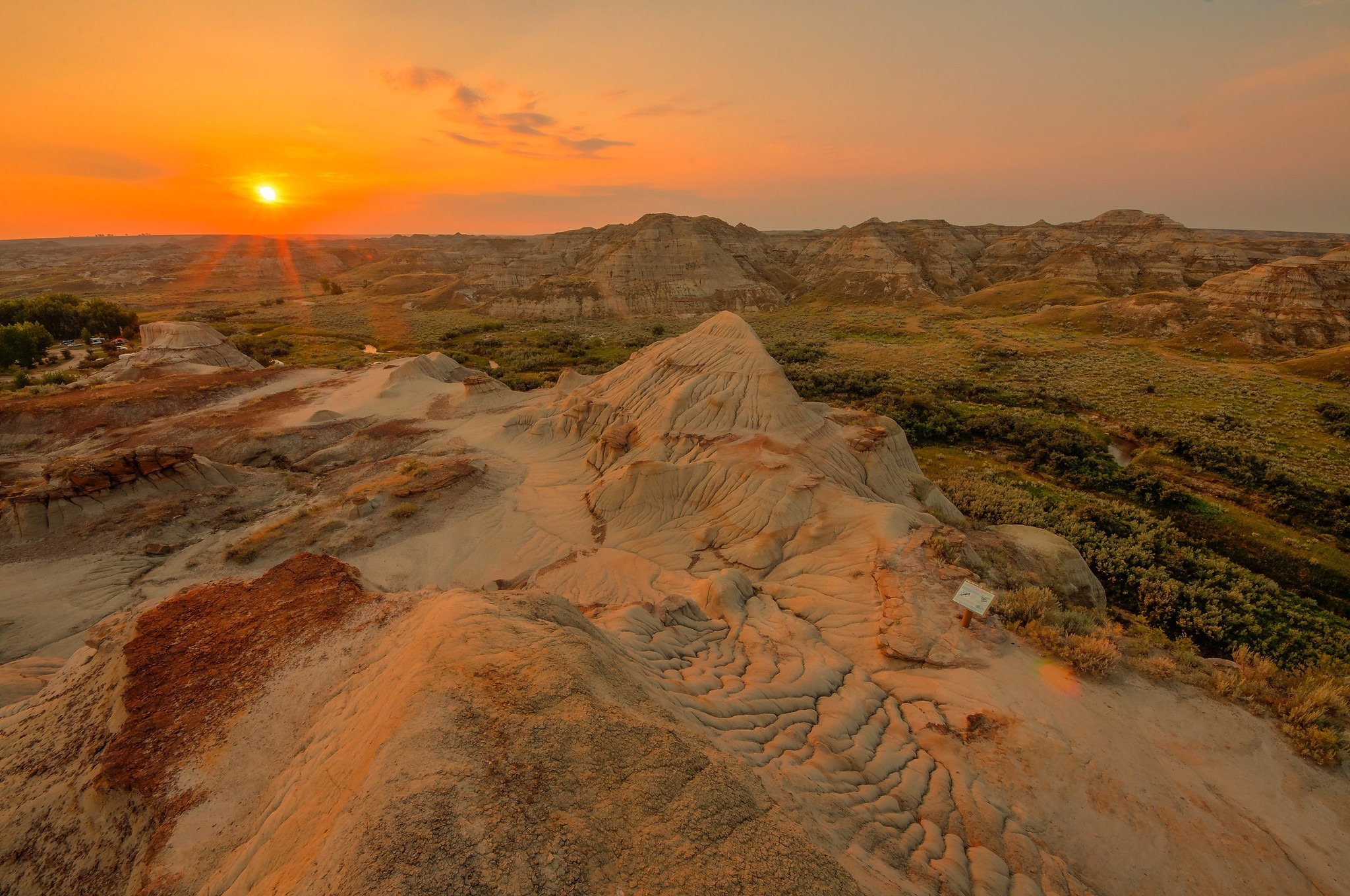
In the heart of the Canadian province of Alberta lies an amazing area that beckons adventurers and antiquities enthusiasts from all over the world. The Valley of the Dinosaurs is not just a beautiful name for a tourist route, but a living textbook of the geological and biological history of our planet, allowing you to look into the depths of time separating us from the inhabitants of the Earth who lived more than 70 million years ago.
The natural heritage of the Cretaceous period
When we talk about the Valley of the Dinosaurs in Alberta, we are primarily referring to the Dinosaur Provincial Park, which was designated a UNESCO World Heritage Site in 1979. This place is located 220 kilometers east of Calgary and 48 kilometers from the town of Brooks, in the valley of the Red Deer River, famous for its picturesque Bedlands.

Bedlands of Dinosor Provincial Park, showing the characteristic landscape of the BritannicaTerritory
Bedlands are a special type of landform resulting from the intense erosion of soft sedimentary rocks by water and wind. There is little vegetation and the soil is too infertile for agriculture, hence the name. But it is this “uselessness” for human economic activity that has made the Bedlands a real treasure trove for paleontologists. The constant erosion of soil layers exposes new fossils, allowing scientists to literally read the pages of Earth’s history.
During the Cretaceous period, which lasted from 145 to 66 million years ago, the area of present-day Alberta looked very different. The climate was much warmer and much of the land was covered by an inland sea. Along the coast of this sea, a rich ecosystem of diverse flora and fauna thrived. When animals died, their remains were buried beneath layers of sediment, where they were eventually transformed into the fossils we find today.
Chronicle in stone: paleontological finds
Dinosaur Provincial Park is considered one of the richest places on the planet for the concentration of dinosaur fossils. The remains of more than 500 specimens belonging to 39 different species of dinosaurs that lived some 75-77 million years ago have been found here. These are truly impressive figures, especially considering the relatively small area of the park – only 73.29 km².

Chasmosaurus skeleton found within the park Wikipedia
Among the dinosaurs whose remains have been found in the park, several main groups can be distinguished:
- Ceratopsidae (horned dinosaurs): chasmosaurus, styracosaurus, centrosaurus, pachyrhinosaurus, and others
- Hadrosaurs (duck-billed dinosaurs): Corytosaurus, Gryposaurus, Lambiosaurus, Parasaurolophus
- Ankylosaurs (armored dinosaurs): Euoplocephalus, Edmontonia, Panoplosaurus
- Tyrannosauridae (predatory dinosaurs): Daspletosaurus, Gorgosaurus
- Ornithomimidae (ostrich-like dinosaurs): Ornithomimus, Struthiomimus
In addition to the remains of the dinosaurs themselves, fossils of other animals that inhabited the area have also been found here: crocodiles, turtles, fish, pterosaurs and birds.
In 2022, a particularly valuable find was made in the park – perfectly preserved body parts of a Hadrosaurus (foot and tail) with fossilized skin. Such finds with preserved soft tissue are extremely rare and are of great interest to science, providing scientists with additional information about the appearance and physiology of ancient lizards.
Royal Tyrrell Museum of Paleontology
Located 110 kilometers west of Dainosor Provincial Park, in the town of Drumheller, is the famous Royal Tyrrell Paleontological Museum, Alberta’s premier center for the study and display of paleontological finds.

TheRoyal Tyrrell Museum of Paleontology The Canadian Encyclopedia’s Royal Tyrrell Museum of Paleontology exhibit
The museum is named in honor of Joseph Burr Tyrrell, a geologist who was the first to discover dinosaur fossils in the Red Deer River Valley in 1884. The museum officially opened on September 25, 1985, and since then, more than 600,000 people have visited the museum.
The museum houses more than 80,000 artifacts, including 40 complete dinosaur skeletons. Among them, the skeletons of Tyrannosaurus and Albertosaurus, one of the most characteristic predatory dinosaurs of the area, named after the province of Alberta, occupy a special place.
Albertosaurus (Albertosaurus sarcophagus) is a genus of theropod dinosaurs in the Tyrannosauridae family that lived in western North America at the end of the Cretaceous Period (about 70-66 million years ago). In size, it was smaller than its famous relative Tyrannosaurus – adults reached 9-10 meters in length and weighed 1.2-1.7 tons. Nevertheless, it was one of the dominant predators of its ecosystem.

Tyrannosaurus skeleton at the Royal Tyrrell Museum Reddit
The Royal Tyrrell Museum offers visitors not only a tour of static displays, but also a chance to see the work of paleontologists in the lab, where scientists dissect and study new finds. The museum is also active in scientific research, educational activities and popularization of science.
Drumheller is the capital of dinosaurs
The town of Drumheller, located 110 kilometers from Calgary, is often referred to as the “dinosaur capital”. Its history is closely tied to paleontological discoveries and coal mining. The town was founded in 1912 and named in honor of Colonel Samuel Drumheller, who purchased the land and discovered coal mines here.

The characteristic landscape of the Bedlands near Drumheller BBC
As well as the Royal Tyrrell Museum, Drumheller is famous for its giant Tyrannosaurus statue, which is believed to be the largest in the world. This 26-meter tall steel and plastic dinosaur is a popular tourist attraction and symbol of the town.
Other interesting places to visit around Drumheller are:
- Horseshoe Canyon, a scenic geologic formation with rich paleontological finds
- Midland Provincial Park – a nature park located 6 kilometers from Drumheller
- Old Atlas Coal Mine – a historical landmark that tells the story of coal mining in the region
- Historic Star Main Bridge – a suspension bridge over the Red Deer River
Life in the Cretaceous Period
To truly understand the significance of the findings in Dinosaur Valley, it’s worth taking a closer look at what life on Earth looked like during the Cretaceous period.
The Cretaceous Period (145-66 million years ago) was the last period of the Mesozoic Era, known as the “Age of the Dinosaurs.” During this time, the planet’s climate was much warmer than today’s, and ocean levels were higher. In what is now North America, there was an inland sea that divided the continent into two parts.
A variety of dinosaurs dominated the land. The Cretaceous period saw the appearance of many dinosaur groups known today, including Tyrannosauridae, Ceratopsidae, and Hadrosauridae. This was a period of their evolutionary flourishing and diversity.
Paleontological finds at Dinosaur Provincial Park World Heritage Sites
An important event of the Cretaceous period was the appearance and spread of flowering plants (covered seeds). Prior to this, the plant world was mainly represented by conifers, ferns, cycads and ginkgoes. The emergence of flowering plants led to evolutionary changes in insects that became pollinators, which in turn affected the entire food chain.
The seas and oceans were also teeming with life. There were a variety of marine reptiles: mosasaurs, plesiosaurs, ichthyosaurs, as well as various species of fish, mollusks and other invertebrates.
The Cretaceous period ended with one of the most dramatic events in Earth’s history, a mass extinction event known as the Cretaceous-Paleogene extinction, which occurred about 66 million years ago. This event resulted in the extinction of all non-avian dinosaurs, as well as many other groups of animals and plants. The most common theory links this extinction to the impact of a large asteroid near the modern Yucatan Peninsula (Chicxulub Crater).
The importance of the Valley of the Dinosaurs to science
Dinosaur Valley in Alberta is of great scientific importance for several reasons:
- Richness and diversity of finds: Fossils of more than 500 dinosaur individuals belonging to 39 species have been found here, making it one of the most important sources of paleontological information in the world.
- Good preservation: Due to the peculiarities of the fossilization process, many finds have been preserved in excellent condition, which allows scientists to study not only bone structures, but sometimes also soft tissues of ancient animals.
- Ecosystem studies: The finds in the park include not only dinosaurs, but also other animals and plants from the Cretaceous period, which makes it possible to reconstruct entire ecosystems.
- Stratigraphic sequence: Sedimentary layers store information about successive changes in ecosystems over millions of years.
- Mass graves: The discovery of mass mortality sites (e.g., Albertosaurus bone clusters) provides scientists with valuable information about the social behavior of dinosaurs.

The colorful landscape of the Bedlands of Dinosaur Valley in Alberta World Atlas
Research based on findings from Dinosaur Valley is helping scientists better understand the evolution of life on Earth, past climate changes, and the causes of mass extinctions. This information has not only historical value, but also helps to better understand modern climate change processes and their possible effects on the biosphere.
How to visit the Valley of the Dinosaurs
For those who want to see this amazing land with their own eyes, there are several opportunities to organize a visit:
Dinosaur Provincial Park:
- Located 220 kilometers east of Calgary and 48 kilometers from the city of Brooks
- Offers a variety of excursions including paleontology tours and scenic trail rides
- The park has a campground for those who want to stay for a few days
- Visits should be planned between May and October, when weather conditions are most favorable
Royal Tyrrell Museum of Paleontology:
- Located in the town of Drumheller, 110 kilometers from Calgary
- It is recommended that you allow at least 2 hours to see all of the exhibits
- The museum offers a variety of educational programs for both children and adults
Drumheller and the surrounding area:
- In addition to the museum, there are many other dinosaur-themed attractions in the city and surrounding areas
- Popular sites include the giant Tyrannosaurus statue, the old Atlas coal mine, Horseshoe Canyon and Midland Provincial Park
To fully explore the Valley of the Dinosaurs, it is recommended to plan a trip of 2-3 days, which will allow you to visit the main attractions of the region without rushing and feel the unique atmosphere of this place, where the history of the Earth literally comes alive under your feet.
Author Information

I’m a journalist specializing in urban issues and city politics in the Vancouver region, which I’ve covered since 1994, and I also have a strong focus on the iGaming industry. In this endlessly changing city, I cover a broad range of issues: from drug policy, bike lanes, billion-dollar development projects, homelessness, and garbage debates, to the rapidly evolving world of online gaming, including regulatory landscapes, technological advancements, and market trends. I write frequently for the Globe and Mail’s B.C. section and Report on Business. From 2008 to 2015, I had a regular column in Vancouver magazine, “Urban Fix,” which apparently resonated with readers so much that it earned me a few regional and national awards.
