
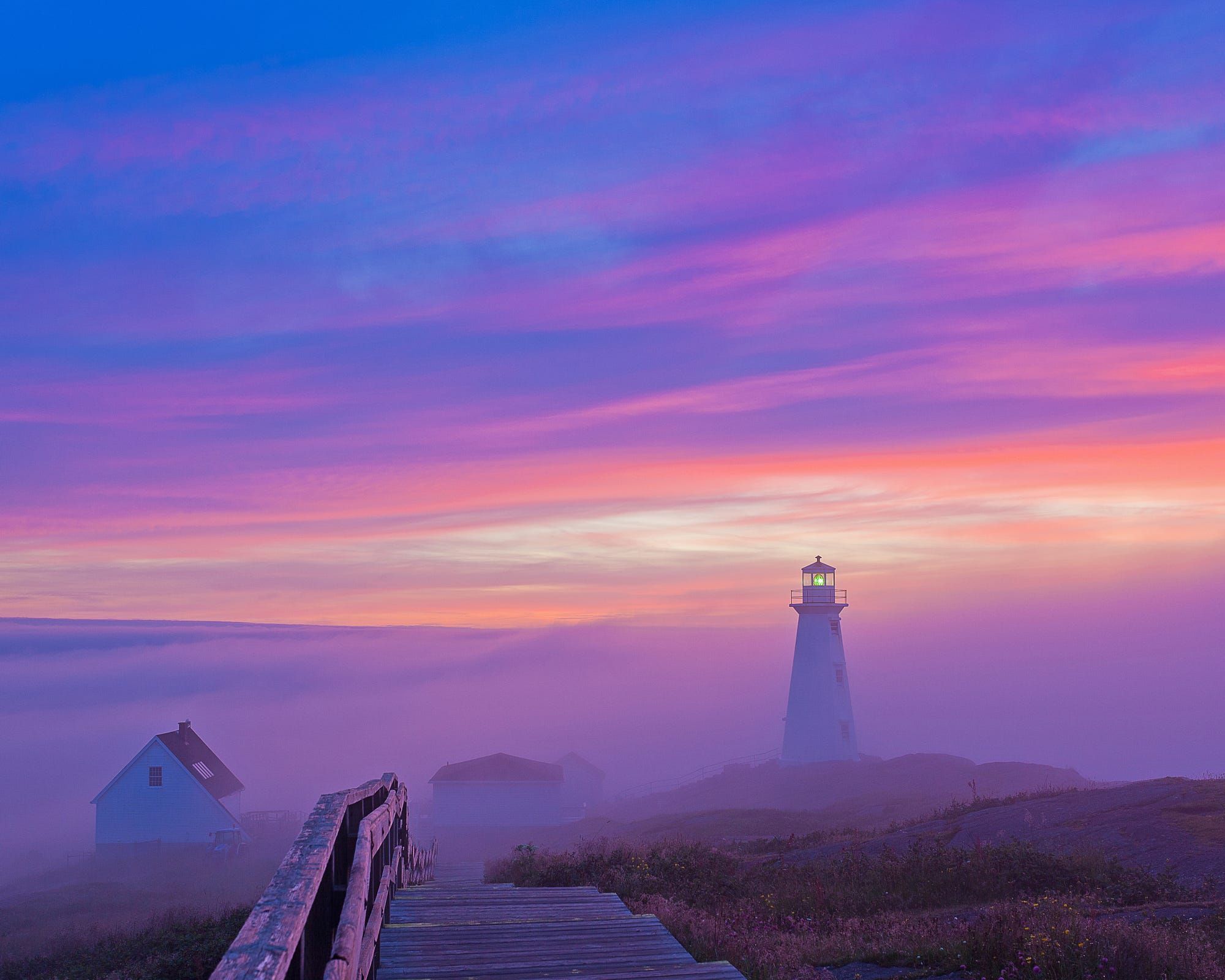
Geographic location and significance
Cape Spear is a majestic promontory located on the Avalon Peninsula in the province of Newfoundland and Labrador in northeastern Canada. This place is known primarily for being the easternmost point not only of Canada, but also of the entire North American continent (excluding Greenland). The Cape’s geographic coordinates are 52°37′ West longitude, making it the first place in North America to greet dawn every day. Wikipedia

Cape Spear rises above the Atlantic coast near the city of St. John’s, the provincial capital of Newfoundland and Labrador. Perched on a granite cliff more than 70 meters above sea level, the Cape is an impressive sight. From its summit you can enjoy breathtaking panoramic views of the vast expanse of the Atlantic Ocean and the picturesque coastline.
History of Cape Spear
Cape Spear’s history is closely tied to Canada’s maritime history. Because of its strategic position at the entrance to St. John’s Harbour, the Cape has always been important to navigation and the safety of shipping in the region.
Cape Spear Lighthouse
The Cape Spear Lighthouse, built in 1836, is the oldest surviving lighthouse in the province of Newfoundland and Labrador. The original lighthouse building and keeper’s residence were erected in 1839 and are a fine example of the architecture of the period. The lighthouse was commissioned in September 1836 and operated continuously until 1955, when a new, modern lighthouse was built. Parks Canada
The old lighthouse is a two-storey cubic neoclassical style building with wood cladding and a low roof. It was designed not only as a navigational landmark, but also as a dwelling for the lighthouse keeper and his family. The interior of the lighthouse has been restored and reflects 19th century life, giving visitors a glimpse into the lives of lighthouse keepers and their families of the time.

Today, there are two lighthouses on Cape Spear: the historic lighthouse, built in 1836, and the modern lighthouse, erected in 1955. The old lighthouse has been fully restored and is now a museum where you can see how lighthouse keepers and their families lived in the 19th century.
Military significance
During World War II, Cape Spear was strategically important for coastal defense. Fortifications and artillery batteries were built here to protect the entrance to St. John’s Harbor from possible German submarine attacks. The bunkers and other wartime defenses remain today and are now part of the Cape’s historical heritage. Travel Gay
Nature and Climate
The nature of Cape Spear is rugged and majestic. The Cape is open to all the winds of the Atlantic, which creates unique climatic conditions. The climate is temperate maritime, characterized by cool summers and relatively mild winters, although the winter months can be quite harsh with strong winds and heavy snowfall.
The coastline of the Cape is granite cliffs that the waves of the Atlantic Ocean crash against. It is an ideal place to watch icebergs in the spring and summer as they drift along the Newfoundland coast. Cape Spear is also a great spot for watching the seabirds and whales that are often seen in the coastal waters. World in Your Imagination
Vegetation on the Cape is sparse due to harsh weather conditions and constant winds from the ocean. It is dominated by low-growing shrubs, mosses and lichens adapted to the harsh coastal conditions.

Cape Spear as a tourist attraction
Today, Cape Spear is a National Historic Site of Canada and one of Newfoundland’s top tourist attractions. It is visited by thousands of tourists each year, attracted by the unique opportunity to visit the easternmost point of North America and be the first on the continent to see the sunrise.
How to get to Cape Spear
Cape Spear is located about 15 kilometers from downtown St. John’s. You can get here by car, cab or as part of an organized tour. There are also hiking trails, such as part of the famous East Coast Trail that runs through Cape Spear. Reddit
The road to the Cape passes through scenic areas, and the trail itself is already part of the experience of visiting Cape Spear. For those who prefer hiking, there is an option to start from Fort Amherst and follow the scenic trail to Cape Spear, which will take about 3 hours.
Activities for visitors
A visit to Cape Spear offers a variety of recreational and educational tourism opportunities:
- Historic Lighthouse Tours – an opportunity to see how lighthouse keepers and their families lived in the 19th century.
- Sunrise Watching – a unique opportunity to be the first in North America to greet the new day.
- Whale and Iceberg Watching – During the spring and summer, passing whales and drifting icebergs can often be seen from the Cape.
- Exploring World War II defenses – a chance to see preserved bunkers and artillery positions.
- Hiking on scenic trails – many trails of varying difficulty for hikers.
- Photography – spectacular views of the ocean and coastline make this place a photographer’s paradise. Parks Canada
To fully explore Cape Spear, it’s recommended that you take half a day – just enough time to see the lighthouse, World War II fortifications and enjoy the scenery. If you’re planning a longer hike along the East Coast Trail, it’s worth planning a full day.

Cultural and historical significance
Cape Spear has tremendous cultural and historical significance for Canada. This place symbolizes the country’s maritime heritage and its connection to the Atlantic Ocean. The historic lighthouse and the surrounding area were declared a National Historic Site of Canada in 1962.
The Cape Spear Lighthouse is a symbol of the City of St. John’s and the entire province of Newfoundland and Labrador. It reflects the important role that maritime navigation played in the history and development of the region.
In addition, the areas surrounding Cape Spear have a rich history of settlement by Irish immigrants, which has contributed significantly to the cultural diversity of the east coast of the Avalon Peninsula. LiveJournal
Practical information for visitors
- Hours of Operation: The lighthouse and visitor center are generally open from May through October, 10:00 am to 6:00 pm. During the winter months, the area is open, but the lighthouse itself and some facilities may be closed.
- Entrance Fee: There is a fee to visit Cape Spear National Historic Site. Check the official Parks Canada website for current prices.
- Facilities: There are restrooms, an information center and a small gift store on site.
- Safety: Care should be taken when exploring the Cape, especially in windy conditions or when visibility is poor. Stick to the marked trails and stay away from the cliff edge.
Author Information

I’m a journalist specializing in urban issues and city politics in the Vancouver region, which I’ve covered since 1994, and I also have a strong focus on the iGaming industry. In this endlessly changing city, I cover a broad range of issues: from drug policy, bike lanes, billion-dollar development projects, homelessness, and garbage debates, to the rapidly evolving world of online gaming, including regulatory landscapes, technological advancements, and market trends. I write frequently for the Globe and Mail’s B.C. section and Report on Business. From 2008 to 2015, I had a regular column in Vancouver magazine, “Urban Fix,” which apparently resonated with readers so much that it earned me a few regional and national awards.
