
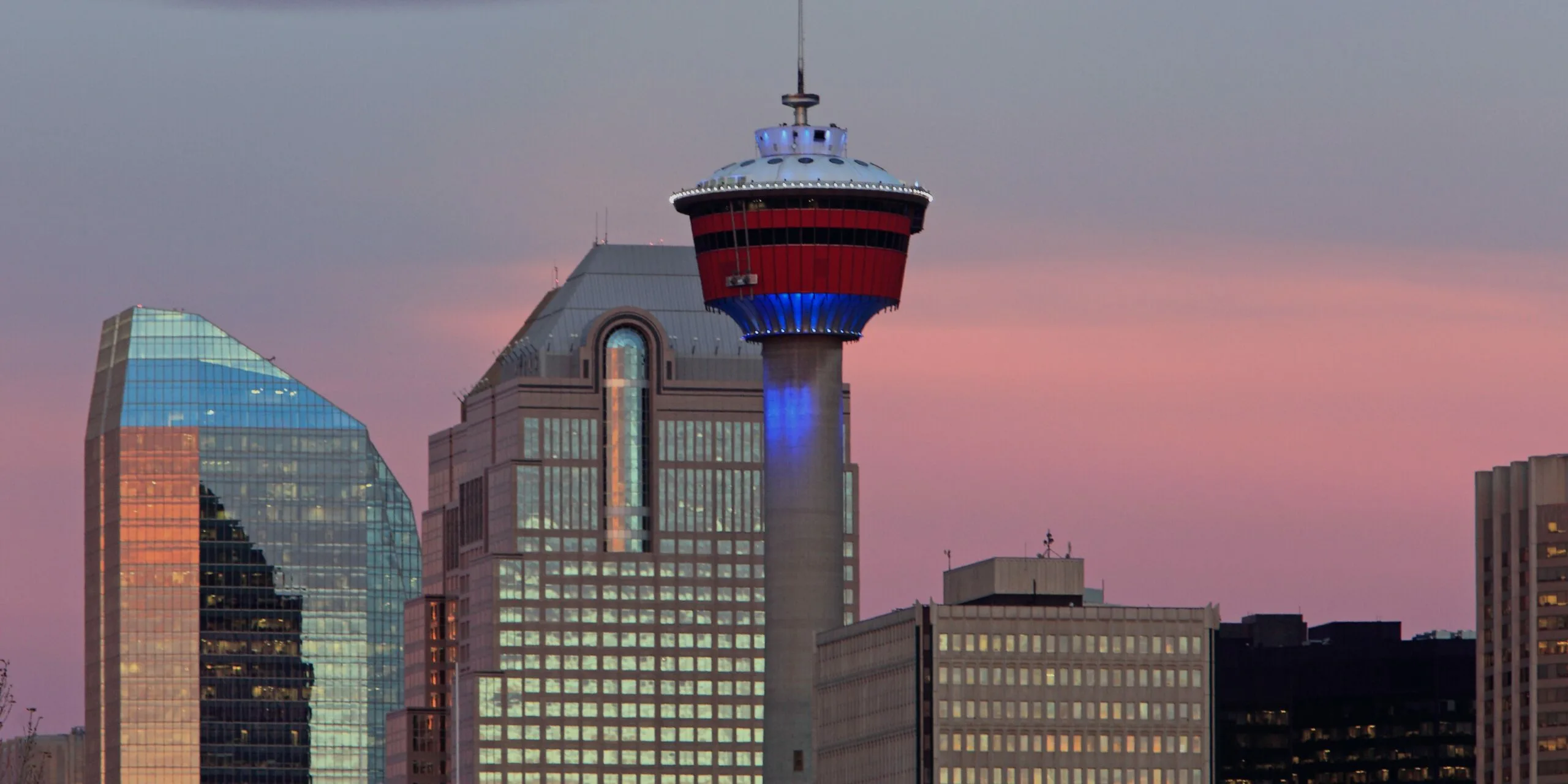
Calgary’s architectural symbol
The Calgary Tower is an impressive 190.8 meter tall structure that towers over the downtown area of Calgary, Alberta, Canada. This free-standing observation tower is not just a tourist attraction, but a true symbol of the city, offering spectacular panoramic views of the cityscape, the Bow River Valley and the majestic Canadian Rocky Mountains.
Originally called the Husky Tower, the tower was conceived as a joint project between Marathon Realty (a subsidiary of Canadian Pacific Railway) and Husky Oil. The construction of the structure was part of an urban renewal program and was timed to coincide with Canada’s centennial in 1967. on November 1, 1971, the tower was renamed the Calgary Tower as a tribute to the people of Calgary.

Creation history
Construction of the tower began on February 19, 1967 and was completed in just 15 months at a total cost of $3.5 million Canadian dollars. A unique method of continuous concrete pouring was used to create the tower column. The process began on May 15, 1967 and was completed in 24 days, at an average rate of 7.6 meters per day, which was recognized by experts as “an amazing achievement of technical and physical mastery.”
Formwork was raised as concrete was poured, and construction workers worked around the clock to erect the tower. When completed, the Husky Tower was the tallest such structure in North America. It dominated the Calgary city skyline, more than twice the height of the previous tallest building in the city, the Elveden House.
Interesting fact: developers deliberately misled the public by stating that the tower would be 187 meters tall, hoping to prevent competing developers from exceeding the Husky Tower height record. Shortly after officials in San Antonio, Texas attempted to claim the record by announcing the completion of the 190-meter Tower of the Americas, developers revealed the true height of Husky Tower. The tower was officially opened on June 28-30, 1968 in three separate ceremonies.
Architectural Features
The tower’s architect was W. G. Milne of A. Dale and Associates. The structure was designed to withstand earthquakes and winds of up to 161 km/h. Although Calgary is not in an earthquake zone, the structure was the first in the western provinces designed to withstand earthquakes.
The tower weighs approximately 10,884 tons, with 60% of that mass underground to provide the necessary stability. On a windy day, the tower can sway up to 16.5 centimeters, which is the norm for such high-rise structures.

The Calgary tower has the following specifications:
- Height: 190.8 meters (626 feet)
- Height to roof: 171 meters (561 feet)
- Height to top floor: 157.6 meters (517 feet)
- Number of elevators: 2
- Number of steps to the observation deck: 802 (not usually open to the public)
Observation deck and panoramic views
Located 191 meters above downtown, the Calgary Tower Observation Deck offers visitors a spectacular 360-degree view of the city and surrounding landscape. The majestic Canadian Rocky Mountains with their snow-capped peaks are clearly visible to the west, while the scenic prairies stretch to the east.
In 2005, a glass floor 36 feet wide (about 11 meters) and 4.5 feet long (about 1.4 meters) was installed on the observation deck as a gift from the Province of Alberta to celebrate its centennial. Standing on the glass floor, visitors can look straight down on 9th Avenue and Centre Street, which creates an unforgettable experience and attracts many tourists.
One of the tower’s features is the rotating Sky 360 restaurant, which makes a full rotation every 45 minutes during the day and every 60 minutes in the evening. The restaurant originally seated up to 200 guests and the observation deck could accommodate up to 250 visitors at a time.
Significant events and modernization
The tower underwent a significant renovation between 1987 and 1990. The addition of a gift store and rotating restaurant were part of a $2.4 million modernization of the upper levels of the tower. A glass rotunda was added in 1990 to serve as a new lobby.
In October 1987, Canadian Western Natural Gas installed a natural gas-powered torch at the top of the tower as a gift for the 1988 Winter Olympics. The torch, which consumes 850 cubic meters of gas per hour, was first lit on February 13, 1988, when the Games opened, and burned around the clock throughout the event. The torch continues to be lit on various special occasions, including Canada Day.
In 1989, the tower became a founding member of the World Federation of Great Towers along with the Eiffel Tower and other famous structures. In 1993, the Calgary Tower celebrated its 25th anniversary and that same year attracted over 500,000 visitors for the first time.
In 2014, an LED multi-color exterior lighting system was installed on the tower. 12 lights were added to the crown and 24 to the exterior floor. Each light was programmed to create more than 16.5 million combinations of color and lighting effects. It has been in use since October 8, 2014, becoming a more prominent part of the city’s night skyline.

Cultural and tourist significance
Although the Petro-Canada Centre West Tower surpassed the Calgary Tower as the tallest structure in Calgary in 1983, the Calgary Tower remains an important symbol of the city and a popular tourist destination.
At the base of the tower is the Vertigo Theater, founded in 1976 originally as the Pleiades Theater. They have been entertaining the city from their location in the Calgary Tower since 2003, presenting a full season of mystery plays for adult and young audiences.
The tower is also equipped with a carillon that was donated to the city by the local Dutch community in 1975 as part of the city’s centennial celebrations. It played daily at noon until 1987, when it was dismantled for storage. The carillon has since been repaired and returned to service.
Author Information

I’m a journalist specializing in urban issues and city politics in the Vancouver region, which I’ve covered since 1994, and I also have a strong focus on the iGaming industry. In this endlessly changing city, I cover a broad range of issues: from drug policy, bike lanes, billion-dollar development projects, homelessness, and garbage debates, to the rapidly evolving world of online gaming, including regulatory landscapes, technological advancements, and market trends. I write frequently for the Globe and Mail’s B.C. section and Report on Business. From 2008 to 2015, I had a regular column in Vancouver magazine, “Urban Fix,” which apparently resonated with readers so much that it earned me a few regional and national awards.
