
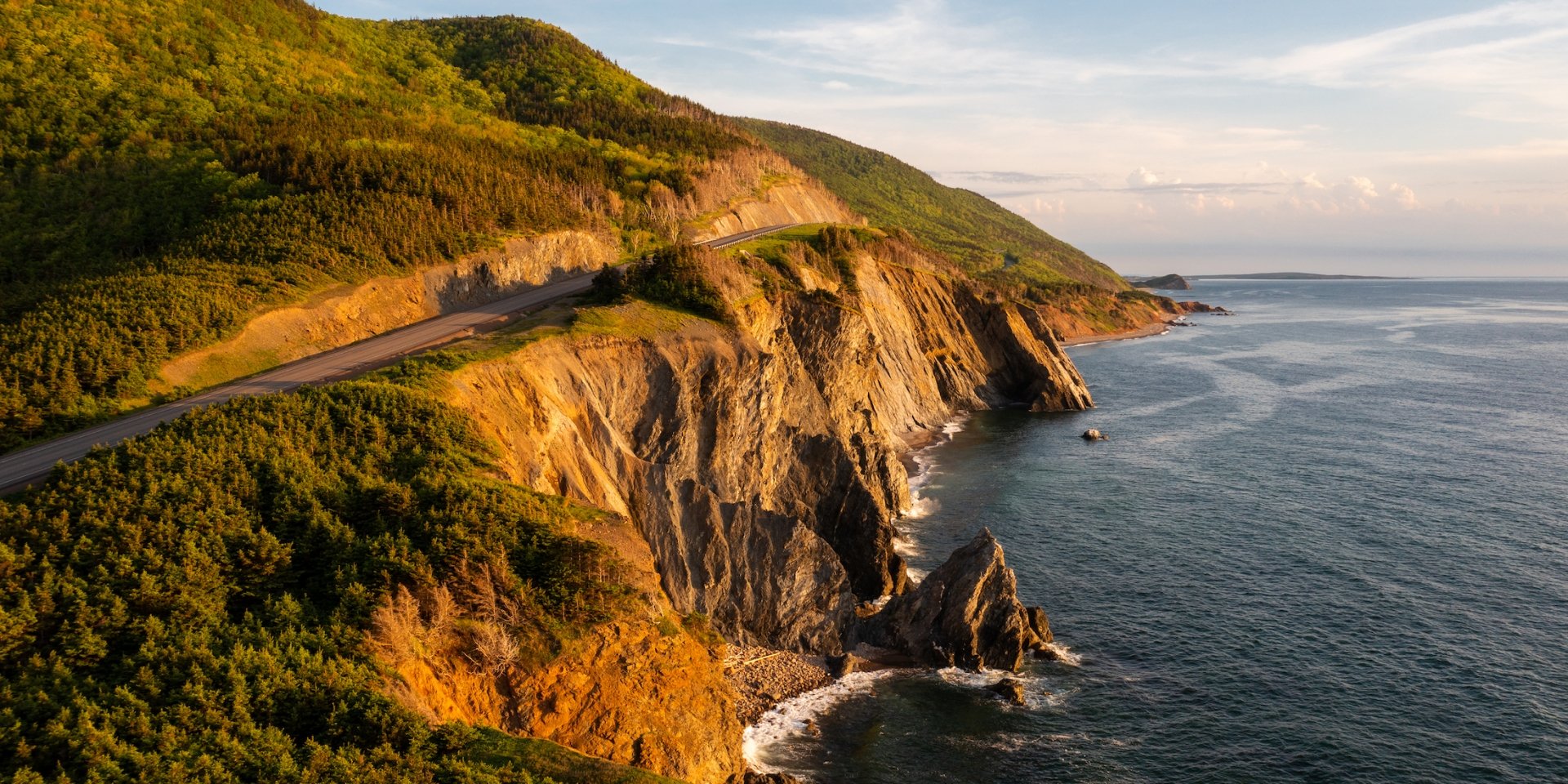
In northeastern Canada, Cape Breton Island is home to one of North America’s most scenic routes, the Cabot Coast. This breathtaking 298-kilometer road skirting the northern tip of the island offers travelers a unique blend of majestic landscapes, cultural richness and unforgettable adventure.
History and Origins
The history of the Cabot coast begins long before Europeans arrived in the area. The first inhabitants of the region were the indigenous Mi’kmaq people, whose name means “my ancestral friends.” They lived in small groups throughout Cape Breton Island before being relocated to reservations.
European exploration of these lands began in 1497 when the famous navigator John Cabot (Giovanni Caboto) arrived on the shores of the island. It was in his honor that this scenic route was named. Cabot’s discovery of the island led to its gradual settlement by Europeans, mostly Scots, Irish, French and English.
Many of these European settlers came to the region fleeing persecution in their homelands. During the expulsion of the Acadians (French-speaking population), many of them fled to Prince Edward Island and Magdalena Island, and later crossed the strait and settled on the lands of the present Cabot coast. The English who settled along the coast arrived as refugees after the American Revolution, when loyalty to the British crown meant land confiscation, social ostracism, and possible death.
The mid-eighteenth century brought great change to the Highlands of Scotland: the era of the clan system was over, the population had increased, and the future seemed bleak. Many were looking for a better place to live and new opportunities. For these reasons, many Scots left their homeland and made new homes in Cape Breton. Since then, Cape Breton has become a stronghold of Gaelic culture, some say more fiercely Scottish than Scotland itself.

The birth of the scenic route
Remarkably, until the early 1930s, it was impossible to travel by automobile through the Cape Breton Mountains. Cheticamp on the western side and the foot of Cape Smoky on the eastern side were the end points; one could only travel further by sea. The communities in the mountains were extremely isolated, supplies could only be brought in by boat, and mail was carried on horseback or by dog sled in the winter.
The beauty of this secluded place did not escape the attention of the provincial government, which saw the potential for tourism in Cape Breton. In 1926, construction began on a road from Cape North to Sheticamp. By the fall of 1927, the route from Sheticamp to Pleasant Bay, a 24-mile stretch through some of the most rugged terrain in North America, was paved. Beyond Pleasant Bay to Cape North, only a walking trail remained.
It wasn’t until 1932 that Rev. R.L. MacDonald became the first person to drive the Cabot Trail. It took him over 10 hours to cover the distance from Sheticamp to Cape North, approximately 50 miles.
In 1936, Cape Breton Highlands National Park was established, covering 950 square kilometers. It was the first national park in the Atlantic provinces of Canada. By 1940, a portion of the Cabot Trail along French Mountain was reconstructed and by 1961 the road was completely paved.
Natural wonders and landscapes
One of the main attractions along the route is Cape Breton Highlands National Park, through which one-third of the Cabot Trail passes. The park offers visitors access to a variety of landscapes ranging from rocky coastlines to lush forests.
The variety of landscapes is astounding: depending on the location, they can resemble Normandy, Hawaii, or Colorado. Winding scenic roads through mountains and forests offer incredible photo opportunities. The park is home to many species of rare or endangered plants and animals, as well as old-growth forests of international importance.
One of the park’s most popular attractions is the Skyline Trail, the most famous hiking trail in the park, best visited at sunset for spectacular views and possible elk sightings. This 7-kilometer loop trail ends at an impressive promontory overlooking the coast. From here, you’ll have an eagle’s eye view of the Cabot Trail winding along the coast.
The park also offers 26 hiking trails of varying difficulty, from easy strolls to challenging climbs. Among them:
- Franey Trail with panoramic views
- Acadian Trail
- Benjies Lake Trail
- Mountain Trail
Wildlife lovers beware: the park is home to elk, beavers, and even coyotes. The best time to see elk is at sunset, especially if you’re traveling on the northern part of the Trail.

Cultural Mosaic
One of the unique features of the region is its cultural diversity. The area is uniquely influenced by three different cultures that are proud to share their heritage with visitors:
- Mi’kmaq Native Culture
- Acadian culture
- Gaelic (Scottish) culture
This cultural diversity is evident everywhere, even in the welcome signs in the national park that read, “Welcome. Bienvenue. Pjila’si. Fáilte.”
Mi’kmak
The Mi’kmak people have lived in this region for ten thousand years, and their culture continues to thrive and enrich us to this day. There are five Mi’kmaq communities on the island: the Escasoni, Membertu, Wagmatcook, Ve’kokma’k, and Potlotek.
To experience Mi’kmaq culture, it’s worth a visit:
Eskasoni Cultural Journeys – the cultural journey includes a 2.4 km trail hike along Lake Bra d’Or and its scenic surroundings. Visitors can learn to dance, make axe handles and cook traditional bread over an open fire.
Membertou Heritage Park – Here you can experience the ancient Mi’kmaq culture, take part in a beading workshop, learn how to make a traditional hand drum or participate in a Medicine Walk.
Acadians
The Acadians have a long history in Cape Breton, beginning over 400 years ago with the arrival of the first European settlers. Their culture thrives along the coasts of the island.
For an introduction to Acadian culture, it is recommended to visit:
Les Trois Pignons Museum – the museum offers a gallery with traditional antiques and contemporary handmade rugs created by local Acadian artisans, as well as masterpieces by world-renowned wool artist Elizabeth Lefort.
Centre de la Mi-Carme – The center offers a unique display of locally made masks and interactive exhibits depicting the evolution of La Mi-Carme, one of the oldest Acadian traditions still celebrated in the area each winter.
Gaelic Culture
On Cape Breton Island, the music and traditions of the Gaelic settlers have been preserved and passed down since the early 1800s. The Scots didn’t just settle here, they made a home out of the language, music and dance that is so characteristic of Gaelic culture.
For an immersion in Gaelic culture it is well worth a visit:
Highland Village – here you can take part in a traditional ceilidh (ceilidh, traditional Gaelic gatherings with music and dance), hear Gaelic singing, learn Gaelic phrases and see animators in historic costumes demonstrate traditional skills such as weaving, quilting and rug making.
Gaelic College/Colaisde na Gidhlig is a non-profit institution offering year-round programs in the culture, music, language, crafts, customs and traditions of immigrants from the Highlands of Scotland.
Culinary delights
The region is famous for its seafood, especially:
- Nova Scotia’s fresh, succulent lobsters, available all along the route
- Local bakeries such as Aucoin Bakery in Sheticamp, known for its cinnamon rolls and oatmeal cookies
- L’abri Cafe in Cheticamp, an LGBT-friendly restaurant famous for its lobster rolls

Best Lookouts
There are many breathtaking lookouts along the Cabot Trail:
- Cape Smokey Look-off – a stunning climb up Cape Smokey allows you to see almost the entire south side of Cape Breton.
- MacKenzie Mountain – panoramic views of Pleasant Bay and the Highlands Plateau.
- Cap Rouge – far-reaching views along the entire Atlantic coast of the region.
- Veteran’s Monument – one of the most famous spots for tourist photo ops, located on the west coast between Cheticamp and Pleasant Bay.
- Lakies Head – a spectacular view of the coastline.
- Sunrise Look-off – the perfect place to watch the sunrise.
Recommended itinerary
For the best experience, a 4-day itinerary is recommended, although 3-5 days will also work. Here’s a suggested itinerary:
Day 1: Cultural Exploration
- Begin by exploring the indigenous Mi’kmaq culture at Eskasoni Cultural Journeys
- Travel to Sheticamp for dinner at L’abri Cafe
- Enjoy a sunset on the Skyline Trail in Cape Breton Highlands National Park
Day 2: Cheticamp Region
- Visit Les Trois Pignons to learn about Acadian history
- Explore the Mi Carme Interpretive Center and take part in mask painting
- Discover the diverse landscapes of Cape Breton Highlands National Park
Day 3: Continue along the coast
- Start with breakfast at Aucoin Bakery
- Drive through Cape Breton Highlands National Park
- Consider the Learn to Lobster Boil experience for an unforgettable culinary adventure
Day 4: Complete the Loop
- Visit local stores such as Groovy Goat Farm & Soap Company
- Stop by historic sites such as Keltic Lodge
- Enjoy the last stretches of scenic coastline

Travel Tips
- Best time to visit: Summer or fall is ideal. Many businesses are seasonal and don’t open until May or June. October offers beautiful fall foliage.
- Direction: You can take the trail either clockwise or counterclockwise – both directions offer stunning views.
- Wildlife Awareness: Beaware of moose and other wildlife while driving.
- Communication: Phone signal and internet can be unreliable; prepare accordingly.
Weather Preparation: Be prepared for warm days and cool nights, as weather can be unpredictable.
Author Information

I’m a journalist specializing in urban issues and city politics in the Vancouver region, which I’ve covered since 1994, and I also have a strong focus on the iGaming industry. In this endlessly changing city, I cover a broad range of issues: from drug policy, bike lanes, billion-dollar development projects, homelessness, and garbage debates, to the rapidly evolving world of online gaming, including regulatory landscapes, technological advancements, and market trends. I write frequently for the Globe and Mail’s B.C. section and Report on Business. From 2008 to 2015, I had a regular column in Vancouver magazine, “Urban Fix,” which apparently resonated with readers so much that it earned me a few regional and national awards.
