
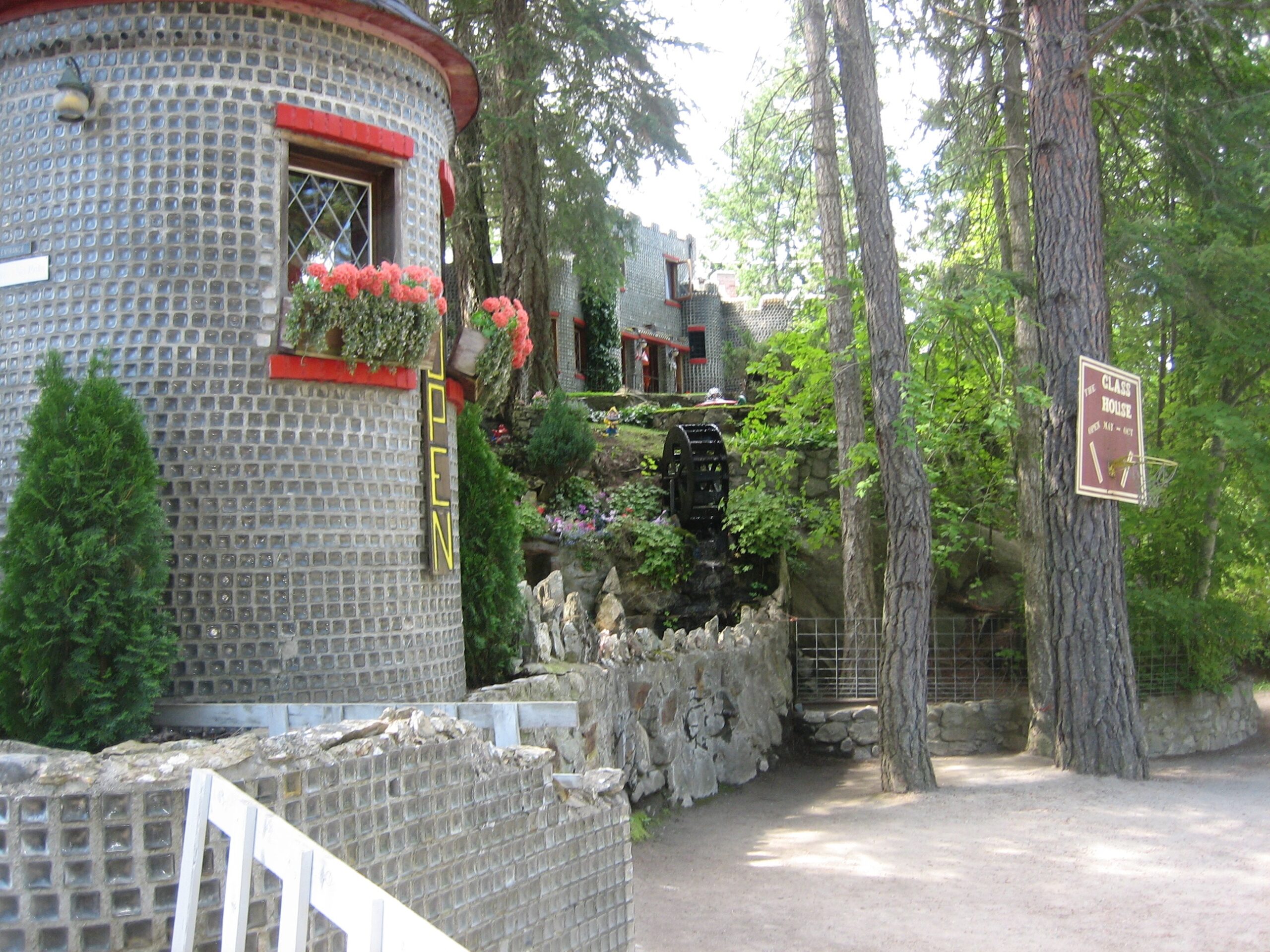
In a picturesque corner of Canada, on the shores of Lake Kootenay in the province of British Columbia, stands a unique architectural structure that attracts the attention of tourists from all over the world. Glass House is an amazing building made entirely of recycled glass bottles, which is a striking example of how recycled materials can be turned into a work of art and an attractive tourist attraction.
The story behind the creation of this unusual building
The story of this unusual structure began in 1952 when British Columbia resident David H. Brown, a retired funeral director, had the idea to create something unique, which he himself described as “satisfying a whim of a special nature.” The solution was quite unusual – to build a house out of empty glass bottles.

Brown traveled throughout Western Canada collecting empty bottles of embalming fluid from his colleagues and friends. He also collected bottles after funeral processions, outside restaurants, in parks, town squares and along roadsides. Many like-minded people joined his idea, and soon the collection grew to an impressive size – about 500,000 glass bottles weighing about 250 tons in total.
Architectural features of the Glass House
The Glass House is a unique structure in the shape of a clover leaf. The house consists of three main circular rooms (each 14.6 meters long and 12.3 meters wide) and a 115 square meter hall located on the second level. The whole building is constructed of glass bottles bonded with cement mortar.
The peculiarity of the construction is that the bottles are stacked with their bottoms facing outwards, creating an amazing visual effect when sunlight penetrates through the walls. The glass bottles shimmer in more than 320 shades, giving the building a magical look, especially in sunny weather.
The interior of the house also reflects the era in which it was created – the 1950s-60s. The décor is in the style of the time, which creates a special atmosphere of nostalgia for visitors.

Landscaping and surrounding area
Equally impressive is the design of the territory around the house. The yard begins at a mountain stream with a moss-covered water wheel installed. Near the house is a “wishing well” bordered with bottles, which creates an additional decorative effect.
The whole Glass House territory is a unified architectural and landscape ensemble, where every detail is thought out and harmoniously fits into the overall design.
Ecological aspects of the project
The Glass House in British Columbia can be considered one of the first major upcycling projects – the creative reuse of materials. Long before recycling became a global trend, David Brown realized the idea of green building by giving a second life to half a million glass bottles.
Building with glass bottles has a number of benefits:
- Environmentally friendly – reusing the materials reduces waste
- Sturdiness – despite their apparent fragility, glass bottles can withstand significant loads (up to 50 kg per square centimeter)
- Resistant to earthquakes – due to their design features
- Fire safety – glass does not burn
- Thermal insulation qualities – the air inside the bottles provides additional thermal insulation
- Aesthetic properties – the play of light penetrating through the glass elements creates a unique visual effect
From a private home to a tourist attraction
Gradually, the unusual structure began to attract the attention of travelers. Seeing the public’s interest, David Brown turned his creation into a roadside attraction open to the public during the summer months.
Today, the Glass House is a popular tourist attraction in British Columbia. Visitors can see not only the unique bottle structure, but also immerse themselves in a mid-century atmosphere thanks to the preserved 1950s-60s interior.

Inspiration for sustainable building
David Brown’s project demonstrated that a creative approach to recycling can result in unique and durable structures. Today, as environmental and sustainability issues come to the forefront, such examples become especially valuable.
The glass house in British Columbia has inspired many other projects around the world. For example, in Canada, on Prince Edward Island, Edward Arsenault, inspired by Brown’s photograph of the house, built his own complex, The Bottle Houses, which has also become a popular attraction.
Practical aspects of building from bottles
Building houses out of bottles is not just an eco-friendly, but also a relatively affordable way to create a dwelling. The technology includes the following stages:
- Collecting and cleaning bottles
- Creating the frame of the future structure
- Laying bottles in rows using cement mortar
- Finishing of external and internal surfaces
Bottles can be laid in different ways – horizontally, vertically, with the bottoms facing outwards or inwards, creating a variety of visual effects and textures.
Bottle House as a cultural phenomenon
The Glass House in British Columbia is not just an unusual structure, but an important cultural object that reflects the post-war spirit of ingenuity and resourcefulness. It demonstrates how human creativity can transform ordinary objects into works of art.
For tourists traveling in the interior of British Columbia near Nelson, a visit to the Glass House is an opportunity to see a unique architectural experiment and to see how even something as mundane as a glass bottle can become the basis for an impressive structure.
Author Information

I’m a journalist specializing in urban issues and city politics in the Vancouver region, which I’ve covered since 1994, and I also have a strong focus on the iGaming industry. In this endlessly changing city, I cover a broad range of issues: from drug policy, bike lanes, billion-dollar development projects, homelessness, and garbage debates, to the rapidly evolving world of online gaming, including regulatory landscapes, technological advancements, and market trends. I write frequently for the Globe and Mail’s B.C. section and Report on Business. From 2008 to 2015, I had a regular column in Vancouver magazine, “Urban Fix,” which apparently resonated with readers so much that it earned me a few regional and national awards.
