
Introduction
The nature of our planet is full of amazing phenomena that make us marvel at its power and beauty. One such spectacular natural wonder is the tides of the Bay of Fundy, located between the provinces of New Brunswick and Nova Scotia on the east coast of Canada. This picturesque bay is known worldwide for its unique phenomenon – the highest tides on the planet, which reach a truly impressive height of up to 16-18 meters. Imagine: the water level rises and falls to the height of a four- or five-story building twice a day! This natural phenomenon attracts thousands of tourists from all over the world who want to see the power and majesty of nature with their own eyes.
In this article, we will take a closer look at what the Bay of Fundy is, why such extreme tides occur here, what unique phenomena they create, and where and when it is best to observe this breathtaking natural spectacle.
Geographical location and characteristics of the Bay of Fundy
The Bay of Fundy (English: Bay of Fundy, French: Baie de Fundy) is located in the northeastern part of the Gulf of Maine, which in turn is part of the Atlantic Ocean. The name of the bay probably comes from the French word “fendu”, meaning “split”, which describes its shape and location quite accurately.
The Bay of Fundy, stretching about 270-300 kilometers in length, separates the two Canadian provinces of New Brunswick and Nova Scotia, and also partially washes the coast of the American state of Maine. The width of the bay is up to 90 kilometers, and the maximum depth reaches 214 meters. In its shape, the Bay of Fundy resembles a natural funnel, narrowing as it moves inland, which is one of the key factors in the formation of record tides.
The Bay of Fundy is an example of a so-called watt sea, a special coastal ecosystem that is regularly flooded at high tide and exposed at low tide, creating a unique habitat for a variety of marine organisms.
The coastline of the Bay of Fundy is highly diverse, with rocky cliffs and steep shores, as well as extensive sandy beaches, marshy areas and salt marshes. Several major rivers flow into the bay, including the St. John and St. Croix, which are also influenced by powerful tides.
History of the discovery and exploration of the bay
Bay of Fundy has a rich history that goes back a long way. The region was first inhabited by indigenous peoples, particularly the Mi’kmaq and Malesite tribes, who lived here long before the arrival of Europeans. They were well aware of the unique nature of the tides and learned to utilize this natural phenomenon for fishing and gathering.
European explorers first visited the Bay of Fundy in the early 17th century. In 1604, French explorer Samuel de Champlain and his team reached these shores and were amazed at the scale of the tides. Champlain named this bay “La Baie Française” (the Gulf of France). The name “Fandi” came later and, as mentioned, is probably a corruption of the French word “fendu”.
Over the following centuries, the shores of the Bay of Fundy became home to European settlers, mostly French and English, who established ports and fishing villages. The Bay’s unique tidal conditions have always played an important role in the lives of local people, influencing shipping, fishing and even farming practices.
Scientific study of the extreme tides in the Bay of Fundy began in the 19th century, and since then the phenomenon has attracted the attention of researchers from all over the world, seeking to better understand the mechanisms behind such an amazing natural phenomenon.
The phenomenon of tides in the Bay of Fundy
Tides are a natural phenomenon observed in all the oceans and seas of our planet. They result from the gravitational pull of the Moon and, to a lesser extent, the Sun on the Earth’s water masses. However, in most places, the difference between sea level at high tide and low tide is relatively small – about 1 meter on average.
The Bay of Fundy, on the other hand, strikes the imagination with its extreme tides, which can reach heights of up to 16-18 meters, which is equivalent to the height of a 4-5 story building! It is this characteristic that makes the Bay of Fundy a world record holder for tidal height. For comparison, the second place in terms of tidal height is occupied by Ungava Bay in Canada with an index of about 16 meters, and the third place is occupied by Cook Inlet in Alaska with tides up to 13 meters high.
In the Bay of Fundy, tides occur twice a day, every 12 hours and 26 minutes. This means that the time between successive high (or low) tides shifts slightly each day, by about 50 minutes. A complete cycle from low tide to high tide and back again takes about 6 hours and 13 minutes.
In one 12-hour tidal cycle, about 100 cubic kilometers of water passes in and out of the bay. This is a staggering volume that is twice the total flow of all the rivers in the world over the same period of time! This huge mass of water creates powerful currents and unique hydrological phenomena, which we will discuss later.
It is important to note that tidal heights in the Bay of Fundy are not always the same. It varies depending on the phase of the moon and the time of year. The highest tides, the so-called “spring tides,” occur during the new and full moons, when the Sun, Moon, and Earth line up and their gravitational forces add up. In contrast, “neap tides” (the least pronounced) occur during the first and third quarter of the Moon, when the gravitational forces of the Sun and Moon partially offset each other.
Causes of extreme tides
Why exactly does the Bay of Fundy experience such spectacular tides? This phenomenon is due to a unique combination of several factors:
- Theshape of the bay: the Bay of Fundy has a characteristic funnel shape that narrows and becomes shallower as it moves away from the ocean. This feature causes the tidal wave to contract and rise higher as it moves deeper into the bay.
- Resonance (seiche): One of the key causes is a phenomenon known as resonance or seiche. Any mass of water in a confined or semi-confined body of water has a natural frequency of oscillation. In the case of Bay of Fundy, its natural period of oscillation is about 12-13 hours, which is strikingly close to the periodicity of the tides (12 hours 26 minutes). This creates a resonance effect, similar to the way a seesaw swings when nudged at just the right moment.
- Depth and bottom topography: The topography of the seabed in Bay of Fundy also contributes to the tidal effects. As you move deeper into the bay, its bottom gradually rises, causing the tidal wave to become even more concentrated and upward.
- Water inertia: The huge masses of water moving during the tidal cycle have considerable inertia, which also contributes to the amplitude of sea level fluctuations in the Bay of Fundy.
All these factors together create conditions for the formation of record high tides, which attract tourists from all over the world and are the subject of scientific study.
Unique phenomena caused by tides
The extreme tides in the Bay of Fundy create a number of unique and spectacular natural phenomena that can be observed in different parts of the bay:
1. Vertical Tidal Effect
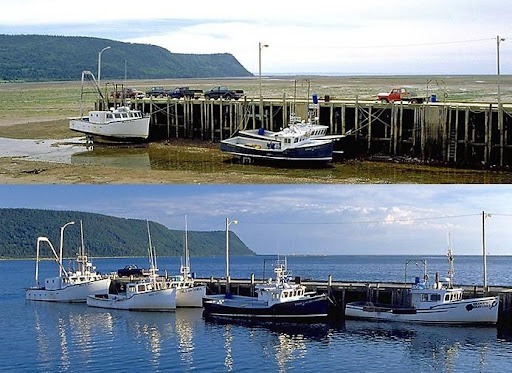
This is the main phenomenon that has made the Bay of Fundy world famous. The vertical effect is best observed at the jetties and marinas around the bay. If you visit the same jetty at high tide, you can see boats and ships floating at the level of the jetty at first, and after 6 hours they are already on the exposed seabed 16 meters below. It’s like dropping them from the height of a 4-5 storey building!
2. Horizontal tidal effect
Equally impressive is the horizontal tidal effect. There are beaches at the top of the Bay of Fundy where the water can recede up to 5 kilometers from the shoreline at low tide. This creates the opportunity for visitors to literally walk on the seabed, exploring the unique coastal ecosystems. However, extreme caution is advised, as the water can return at speeds of more than 10 meters per minute, making unprepared stays in the littoral zone potentially dangerous.
3. Tidal Bore
One of the most spectacular tidal phenomena in the Bay of Fundy is the tidal bore. This phenomenon occurs at the mouths of rivers flowing into the bay. When a tidal wave enters a narrow river channel, it forms a standing wave that moves upstream of the river, against its natural direction. Such a wave can reach a height of 3-3.5 meters and a speed of 15 km/h. The sound of an approaching tidal wave is often compared to the rumble of an approaching train. It is a rare natural phenomenon that can only be observed in a few places around the world.
4. Tidal rapids, whirlpools and waterspouts
Due to the complex topography of the shoreline of the Bay of Fundy, with numerous headlands and narrow straits, the flow of 100 billion tons of water twice a day creates powerful whirlpools and tidal rapids. The most famous whirlpool in the Bay is Old Sow, located in Passamaquoddy Bay closer to the mouth of the Bay of Fundy. It is the largest maelstrom in the Western Hemisphere and the second largest in the world! During maximum tidal currents, the diameter of this whirlpool can reach 75 meters.
5. Reversible waterfalls
In the city of St. John, located on the shores of the bay, you can observe a unique phenomenon – reversible waterfalls. They form where the St. John River flows into the Bay of Fundy through a narrow gorge. At high tide, the water level in the bay rises so high that it exceeds the level of the river, and the flow of the river is reversed, creating waterfalls that flow in the opposite direction. This amazing sight attracts many tourists.
Geologic formation and rock formations
The geologic history of the Bay of Fundy dates back millions of years and is closely related to the formation of the Atlantic Ocean. About 200 million years ago, at the beginning of the Mesozoic Era, the supercontinent Pangaea began to break up, leading to the formation of the Atlantic Ocean and the separation of the continents. The area that is now the Bay of Fundy was the site of intense geologic processes, including volcanic activity, sediment deposition, and tectonic movements.
During the Triassic period, the area of the present-day bay was covered by thick layers of basaltic lava that formed what is known as the Fandi Basin. These volcanic deposits can still be seen in some coastal areas, such as the basalt cliffs of Cape Enrage in New Brunswick.
Over time, as the Atlantic Ocean expanded, the Bay of Fundy region experienced intense riftogenesis and extension. This has resulted in the formation of numerous faults and fractures in the Earth’s crust, which, combined with the unique shape of the bay, contribute to the tidal effects.
The constant exposure to powerful tides has formed amazing rock formations along the shores of the bay. Erosion has gradually eroded away the soft sedimentary rocks, creating spectacular cliffs, sea stacks and caves. The most famous of these are:
Hopewell Rocks (Flower Pots)
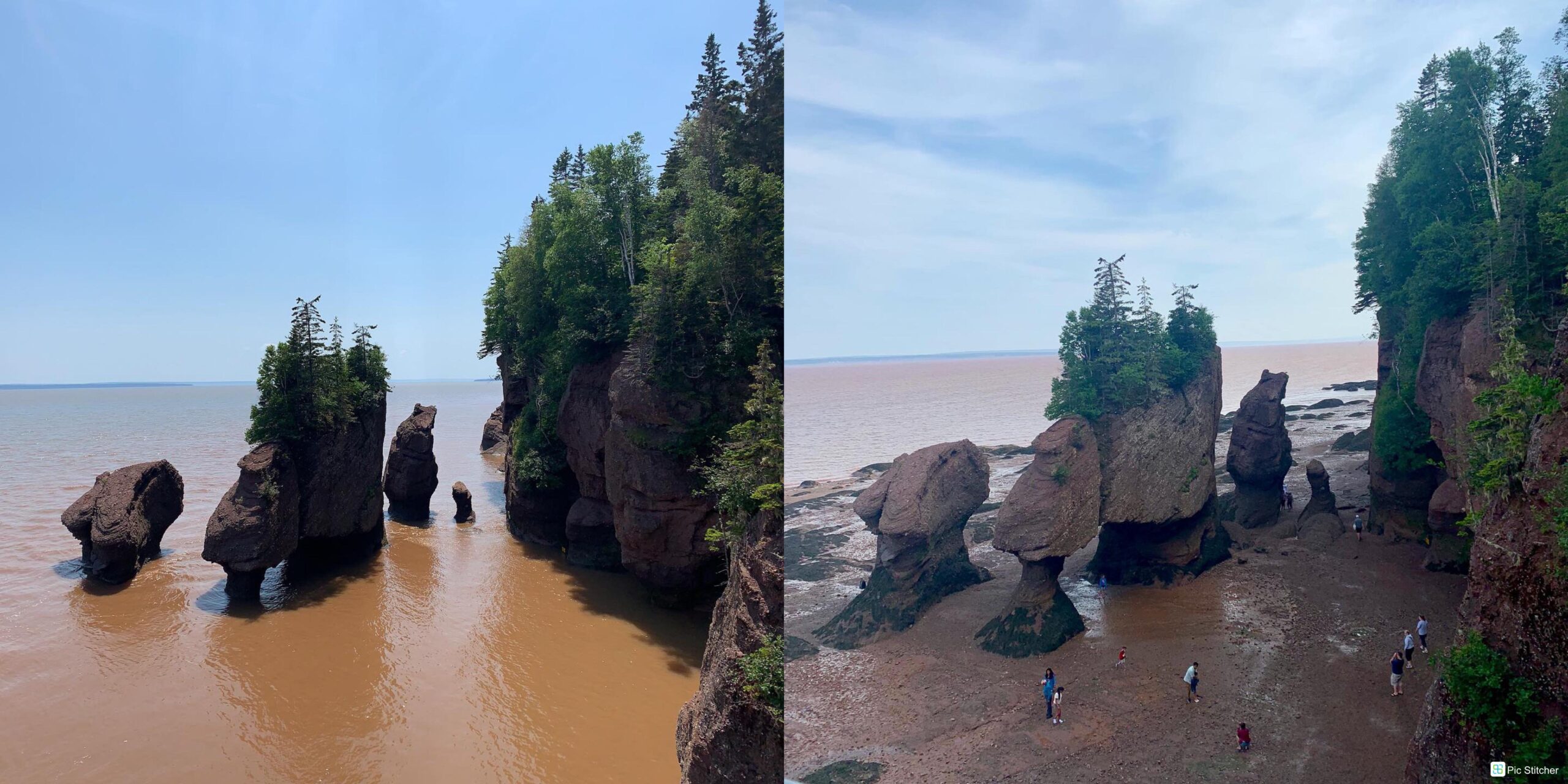
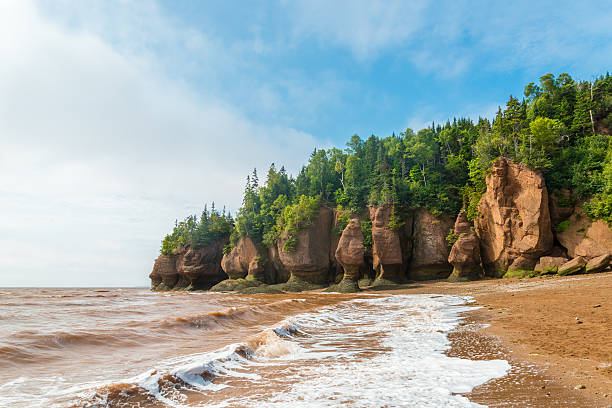
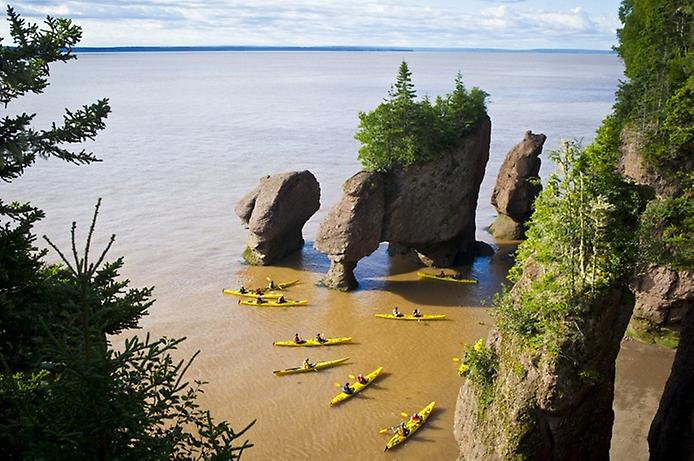
These unique rock formations are located on the coast of New Brunswick and are a hallmark of the Bay of Fundy. They are composed of red sandstone and have a distinctive shape resembling giant flowerpots – wide at the bottom and tapering towards the top, with trees and shrubs growing on their tops. This unusual shape is the result of differential erosion: the lower part of the cliffs is constantly exposed to the tides, which causes it to gradually erode and create characteristic constrictions.
At low tide, visitors can walk on the seabed around these impressive formations, while at high tide the tops of the cliffs turn into small islands surrounded by water. This creates an amazing opportunity to see the same place in completely different conditions just a few hours apart.
Joggins Fossil Rocks
Located in Nova Scotia, these cliffs are recognized as a UNESCO World Heritage Site. They contain a rich collection of fossils from the Carboniferous period, some 300 million years old. Constant tidal erosion has gradually exposed new layers of rock, opening up access to previously hidden fossils, making this area particularly valuable to paleontologists.
Three Sisters and Cape Chignecto
These picturesque rock formations are also the result of the long exposure of coastal cliffs to tides. They are isolated sandstone pillars standing in the sea close to the shore – evidence of a once continuous coastline gradually eroded by erosion.
All of these geologic landmarks clearly demonstrate the power of the tides of the Bay of Fundy and their ability to shape the landscape over millennia.
The ecosystem of the Bay of Fundy
The unique tidal conditions of the Bay of Fundy have created a distinct ecosystem with high biodiversity and specialized species that have adapted to living in extreme tidal conditions.
Marine life
The waters of the Bay of Fundy are exceptionally rich in nutrients due to the intense mixing of the water layers during high tides. This creates ideal conditions for the development of plankton, which is the base of the food chain and attracts many marine animals to the bay.
The Bay of Fundy is an important habitat and feeding area for many species of whales. Fin whales, humpback whales, minke whales, and endangered northern right whales can be found here. The bay is also home to dolphins, porpoises, seals and many species of fish.
Coastal zone
The littoral (intertidal) zone of the Bay of Fundy is a special world that is underwater and on land twice a day. It is home to specialized organisms that can survive in such extreme conditions: various species of mollusks, crustaceans, marine worms and algae.
Particularly interesting are the tide pools – small depressions among the rocks that remain filled with water even at low tide. These small microcosms are full of life and represent a natural laboratory for studying the adaptations of living organisms to complex conditions of existence.
Salt marshes and swamps
The upper parts of the Bay of Fundy are surrounded by extensive salt marshes and salt marshes, special ecosystems that are periodically inundated during high tides. These areas are of great ecological importance: they serve as natural filters to clean the water of pollutants, prevent coastal erosion, and provide habitat for many species of birds, fish, and invertebrates.
Birds
Bay of Fundy lies on an important bird migration route known as the Atlantic Flyway. During seasonal migrations, millions of birds stop in the Bay to rest and feed. Waders and other shorebirds are especially abundant, feeding on small invertebrate animals that live in the silt of the intertidal zone.
The Bay of Fundy ecosystem is protected by several conservation programs including Fundy National Park, UNESCO Biosphere Reserve and various wildlife sanctuaries.
Best places to see the tides
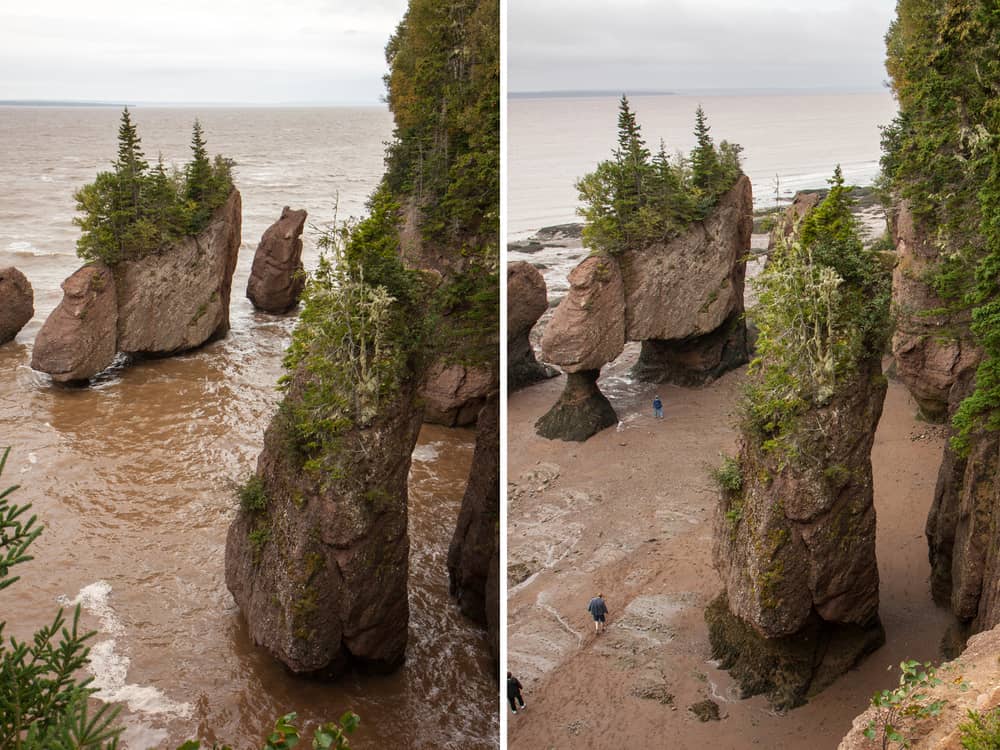
For those who want to see the highest tides in the world with their own eyes, the Bay of Fundy offers several ideal locations:
1. Hopewell Rocks, New Brunswick
This is perhaps the most famous and visited tide-watching location in the Bay of Fundy. The absolute world record for tidal height has been recorded here – up to 18 meters! Visitors can walk along the seabed around the famous “flowerpot” rock formations at low tide and see these same rocks partially submerged in the water at high tide. Hopewell Rocks Park is equipped with observation decks, stairs for safe beach access and information centers. It’s a great place for a family visit.
2. Burntcoat Head, Nova Scotia
Located in Minas Bay (an offshoot of Bay of Fundy), Burntcoat Head is also known for its extreme tides. It is home to an officially recorded maximum amplitude tide measuring point. The park offers guided tours that explain the tidal phenomenon and the geologic formation of the region.
3. Fundy National Park, New Brunswick
This scenic park offers not only tide gazing, but also the opportunity to enjoy other natural attractions such as dense forests, waterfalls and diverse wildlife. Visitors can hike along the shoreline trails, which offer great views of the bay.
4. Reversible Waterfalls in St. John’s, New Brunswick
As mentioned above, the unique phenomenon of reverse waterfalls can be observed at the mouth of the St. John River. Special viewing platforms and bridges have been built for comfortable viewing of this phenomenon.
5. Hopewell Cape, New Brunswick
This cape offers not only spectacular tidal views, but also the opportunity to see other geological features of the Bay of Fundy. Here you can take a guided tour that will explain the history of the formation of the bay and its unique features.
6. Digby and St. Mary’s Bay, Nova Scotia
Located at the southern end of the Bay of Fundy, these places are known for their picturesque harbors and fishing villages. Although the tide heights here are not as extreme as in the upper part of the bay, the difference between high and low tide is still impressive at around 8-10 meters.
7. Annapolis Valley, Nova Scotia
This is a fertile valley surrounded by two mountain ranges where you can see how the tides affect farmland and the local way of life. It is home to historic settlements and farms, many of which have adapted their farming practices to the unique tidal conditions of the region.
When is the best time to observe the tides
To maximize the experience of watching the tides of the Bay of Fundy, it’s important to choose the right time to visit.
As mentioned above, there are two high tides and two low tides in Bay of Fundy every 24 hours, with an interval of about 6 hours and 13 minutes between high and low water levels. The tide times shift by about 50 minutes each day, so it is worth checking the current tide schedule for a particular location before visiting.
For the best observations, it is recommended that you plan your visit during ‘spring tides’, which occur during the full moon and new moon. During these periods, the difference between high and low tide reaches maximum values. Information about tide times and heights can be found on the internet, in tourist centers or in special smartphone apps.
The ideal visiting strategy is to arrive at the chosen site about an hour before low tide, spend time exploring the exposed seabed, and then stay and watch the water gradually return. If time permits, you can return 6 hours later to see the same spot during the opposite phase of the tide. This approach will allow you to fully appreciate the scale and strength of the tidal phenomenon of Bay of Fundy.
In terms of season, Fandi Bay can be visited all year round, but most tourist facilities and services are available between May and October. The summer months (June-August) provide the most comfortable weather for exploring the tidal zone, but they are also the busiest tourist season.
Activities and tourism in the Bay of Fundy
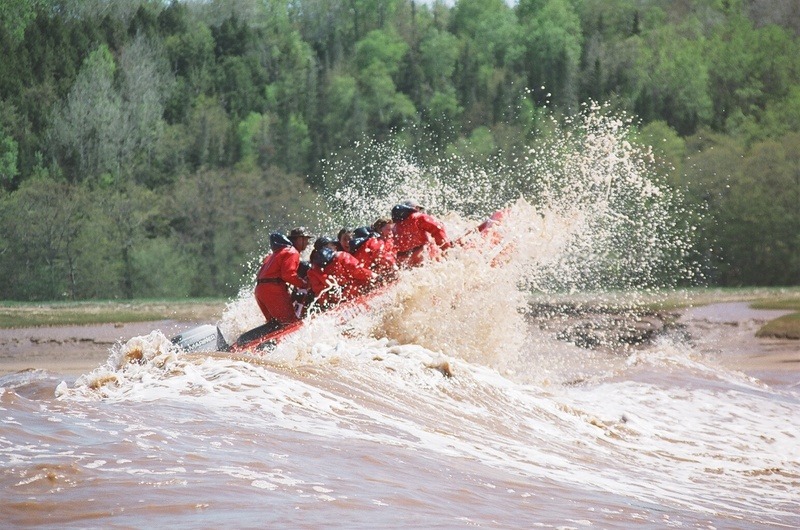
Beyond just tide watching, Fandi Bay offers a wide variety of activities for tourists:
1. Tidal Wave Rafting
This is a unique opportunity to ride an inflatable raft on the tidal wave traveling upstream of the rivers that flow into the Bay of Fundy. This activity is especially popular on the Shubenacadie River in Nova Scotia. Experienced guides lead tourists through the rough waters formed when a tidal wave collides with the river current. The waves can reach a height of 3-3.5 meters, making this experience an unforgettable adventure. This is a rare outdoor activity that is only available in a few places in the world where the tidal wave phenomenon is observed.
2. Kayaking and Canoeing
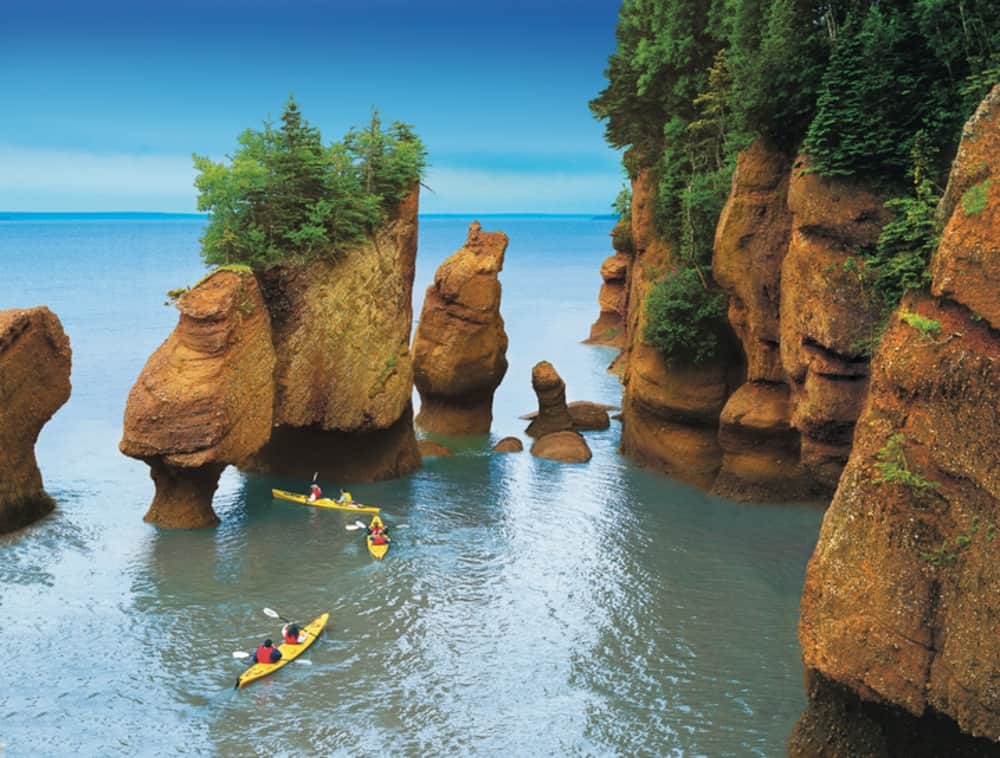
Exploring the Bay of Fundy by kayak or canoe allows you to see the coastline from a completely different perspective. However, keep in mind that strong tidal currents require some skill and experience. Beginners are advised to join organized tours or hire a local guide who is familiar with the local tides and currents.
3. Whale Watching
The nutrient-rich waters of the Bay of Fundy attract a variety of whale species, making the area one of the best whale watching destinations in North America. Fin whales, humpback whales, minke whales, minke whales, and even the rare northern right whales can be seen here from June through October. Numerous tour companies in the harbor towns around the bay offer boat tours specifically to see these majestic marine mammals.
4. Hiking trails
There are many scenic hiking trails of varying degrees of difficulty along the shoreline of the Bay of Fundy. Fundy National Park is particularly known for its network of trails through a variety of landscapes, from coastal cliffs to dense forests and waterfalls. The Fundy Trail and Coastal Trail offer spectacular bay views and wildlife viewing opportunities.
5. St. Martin Sea Caves
In the village of St. Martin, New Brunswick, you can explore spectacular sea caves carved into the coastal cliffs by the constant action of the tides. At low tide, visitors can enter these caves and marvel at their amazing geology. This is a great example of how the tides have shaped the coastline of the Bay of Fundy over millennia.
6. Photography and Art
The dramatic landscapes of the Bay of Fundy, the stark contrast between high and low tide, and the unique rock formations make this region a photographer’s and artist’s paradise. Many local galleries feature works inspired by the beauty of the bay and its tides. For those who are into photography, it is especially recommended to capture the same place during high and low tide – the contrast between the two states is impressive.
7. Culinary Experiences
The Bay of Fundy region is also known for its culinary traditions, especially seafood. Local restaurants offer the freshest lobsters, scallops, oysters and other seafood caught right in the bay. Digby, Nova Scotia, hosts an annual scallop festival, and the town is known as the “scallop capital of the world.” Many farms in the region produce organic produce as well as unique local specialties such as seaweed jam.
The scientific value of the Bay of Fundy
The Bay of Fundy is of great interest to the scientific community due to its unique characteristics and phenomena. Researchers from various fields of science study this region to better understand natural processes and their impact on the environment.
Oceanography and tidal power generation
The extreme tides of the Bay of Fundy make it an ideal natural laboratory for studying tidal dynamics. Scientists investigate aspects such as the interaction of tidal currents with seafloor topography, resonance phenomena in semi-enclosed bodies of water, and the impact of tides on shoreline formation.
In addition, the Bay’s powerful tidal currents represent a potential source of renewable energy. Experimental tidal power plants have already been installed in the Bay, and researchers are working to improve technologies for efficient and environmentally friendly utilization of this natural resource. Experts estimate that the potential for tidal energy in the Bay of Fundy is enormous – the bay could generate billions of kilowatt hours of electricity annually, comparable to the output of several large nuclear power plants.
Geology and paleontology
The shoreline of the Bay of Fundy is a veritable paradise for geologists and paleontologists. The constant erosion caused by the tides exposes new layers of rocks and fossils, some of which date back to a period when the first vertebrate animals were just beginning to appear on Earth.
Especially famous are the Joggins Fossil Rocks in Nova Scotia, recognized as a UNESCO World Heritage Site. Fossils of the oldest terrestrial reptiles have been found here, as well as plant imprints from the Carboniferous period, which help scientists reconstruct the picture of life on Earth more than 300 million years ago.
Ecology and biodiversity
The unique ecosystem of the Bay of Fundy, shaped by extreme tides, is the subject of intensive ecological research. Scientists study the adaptations of different organisms to life under the ever-changing tidal regime, the interactions between different species in the intertidal zone, and the impact of climate change on this fragile ecosystem.
Special attention is given to the study of marine mammals living in the bay, especially the endangered northern right whales. The scientific data collected from these studies play an important role in developing conservation strategies to protect the biodiversity of the Bay of Fundy.
Nature conservation and sustainable development
The unique nature of the Bay of Fundy faces various threats including climate change, pollution, over-fishing and increasing human impact. Various conservation initiatives are being undertaken to preserve this natural wonder.
Fundy National Park, established in 1948, covers a significant portion of the Gulf coastline and is a key component of the conservation strategy for this unique region. The park not only protects a variety of ecosystems, but also conducts educational programs to educate visitors about the unique features of the Bay and the importance of conservation.
In 2007, the Bay of Fundy was included in the UNESCO Global Network of Geoparks, emphasizing its importance as a world-class geological heritage site. Geopark status promotes sustainable tourism and educational programs focused on geoconservation.
Local communities and organizations also contribute to the protection of the Bay of Fundy. There are regular shoreline cleanups, monitoring of marine animal and plant populations, and information campaigns to raise awareness of the importance of preserving this unique natural system.
Sustainable tourism is another important aspect of the Bay of Fundy conservation strategy. Local tour companies and guides strive to minimize environmental impact by adhering to responsible tourism practices and educating visitors about the fragility of local ecosystems.
Cultural significance and history
Bay of Fundy plays an important role in the cultural heritage of Canada’s east coast. For thousands of years, it has been home to indigenous peoples, particularly the Mi’kmaq and Malesite, who adapted their way of life to the unique tidal conditions of the Bay. They used their knowledge of tidal cycles to fish and gather seafood efficiently, and developed a rich mythology and traditions associated with the sea.
With the arrival of European settlers in the 17th century, a new chapter in the region’s history began. The French colonists, known as Acadians, created engineering systems to drain and utilize the salt marshes for agricultural purposes. They built dikes and locks to control the tides and create fertile farmland. Many of these historic sites have survived to this day and are important cultural monuments.
In the 18th century, following the British conquest of the region, many Acadians were deported, and new settlers, mostly from Britain and the American colonies, continued to adapt the local environment to their needs. Fishing, shipbuilding, and maritime trade became the backbone of the economies of the coastal towns.
Today, this rich history is reflected in the many museums and historic sites around Bay of Fundy. Visitors can learn about indigenous life, Acadian history, the development of shipping and fishing, and how the tides have shaped the culture and way of life of local communities over the centuries.
Practical tips for visitors
If you’re planning to visit Bay of Fundy to see the highest tides in the world, here are some practical tips to help make your trip as comfortable and memorable as possible:
Safety first
The tides in the Bay of Fundy are not only spectacular, but also potentially dangerous. Water can arrive at a rate of over 10 meters per minute, which can easily catch an unprepared visitor off guard. Always look out for information signs indicating danger zones, and never ignore warnings from lifeguards or park rangers.
If you are exploring tidal areas or sea caves at low tide, always consider the time when the tide will begin to rise and plan your return with enough reserve. It is recommended that you carry a tide schedule and a wristwatch.
Trip Planning
The best time to visit Bay of Fundy is from May to October, when the weather is most favorable and all tourist facilities and services are fully operational. July and August are the peak tourist season, so if you prefer to avoid the crowds, consider visiting in June or September.
To fully appreciate the magnitude of the tides, plan to stay in the region for at least two days. This will allow you to see at least one full tidal cycle. Check the tide schedules in advance for the specific locations you plan to visit, as tide times and heights can vary greatly from one part of the Bay to another.
What to bring
- Waterproof shoes or rubber boots for exploring the tidal zone
- Several layers of clothing as the weather can change quickly
- Sunscreen and a hat
- A camera or smartphone with a good camera to capture the contrast between high and low tide
- Binoculars for whale and bird watching
- Tide schedule (can be downloaded as a smartphone app)
Transportation and accommodation
There are many accommodation options in the Bay of Fundy region, from campgrounds in national parks to cozy B&Bs and comfortable hotels in coastal towns. During high season, it is recommended to book accommodation in advance.
To get around the region, it is most convenient to rent a car, as many attractions are located at a considerable distance from each other and public transportation is limited. The main roads around the bay are well-maintained, but secondary roads may be required to access some remote locations.
Conclusion
The Bay of Fundy represents one of the most amazing natural wonders of our planet. Its record-breaking tides, reaching heights of 16-18 meters, create unique landscapes, ecosystems, and natural phenomena that amaze us and remind us of the power of natural forces.
A visit to the Bay of Fundy is not only an opportunity to see the highest tides in the world, but also a chance to experience the rich ecosystem, historically important region and welcoming local communities whose lives have been shaped by this amazing natural phenomenon for centuries.
Whether it’s watching the tidal wave, exploring the seabed at low tide, rafting on rough waters or simply contemplating the majestic scenery, the Bay of Fundy offers a variety of experiences that will stay with you for a lifetime. This unique corner of our planet reminds us of how beautiful and amazing nature is, and our responsibility to preserve these natural wonders for future generations.
If you are looking for a place where you can get in direct contact with the forces of nature and witness one of the most impressive tidal phenomena on Earth, the Bay of Fundy should definitely be on your must-see list. With the moon, sun and the bay’s unique geography playing a grand spectacle every six hours, anyone who is ready to embark on this exciting journey can be a spectator.
Author Information

I’m a journalist specializing in urban issues and city politics in the Vancouver region, which I’ve covered since 1994, and I also have a strong focus on the iGaming industry. In this endlessly changing city, I cover a broad range of issues: from drug policy, bike lanes, billion-dollar development projects, homelessness, and garbage debates, to the rapidly evolving world of online gaming, including regulatory landscapes, technological advancements, and market trends. I write frequently for the Globe and Mail’s B.C. section and Report on Business. From 2008 to 2015, I had a regular column in Vancouver magazine, “Urban Fix,” which apparently resonated with readers so much that it earned me a few regional and national awards.
